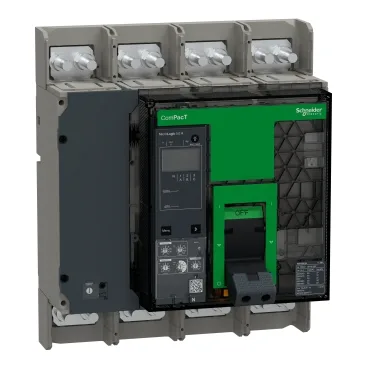
The C160N45AFM is a Schneider Electric ComPacT NS new generation 4-pole fixed-mount circuit breaker carrying a 1600 A MicroLogic 5.0 A electronic trip unit. That 1600 A rating at 50 °C sets the continuous current limit for the main bus or feeder it protects — sized for a large distribution board feeding multiple downstream panels or a heavy industrial load. The MicroLogic 5.0 A trip unit provides LSI protection: long-time overload (L), short-time short-circuit (S), and instantaneous short-circuit (I). The electronic trip means you can adjust the pickup and time-delay settings on-site via the LCD display without swapping trip units. Thermal memory holds for 20 minutes after a trip, preventing immediate reclose into a still-hot cable — a detail that matters when coordinating with downstream breakers on a motor-starting or welding load. Mounts fixed to a backplate with a 70 mm connection pitch — standard for panel builders running busbars or cable lugs. Front connections top and bottom simplify busbar runs in a switchboard lineup. IP40 enclosure protection and IK07 impact resistance suit indoor distribution panels where occasional tool contact is expected.
Integration notes
At 327 mm high, 280 mm wide, and 147 mm deep, the C160N45AFM occupies a standard fixed-mount footprint for a 1600 A frame. The 70 mm connection pitch matches common busbar drilling patterns. Front connections top and bottom allow straight-through bus runs or cable ladders without rear access. The LCD display and four red fault-indication LEDs plus one yellow overload LED give visible status without opening the door — useful during commissioning and fault-finding. Power dissipation is 74 W at rated current — account for that heat in the enclosure sizing if the breaker is enclosed rather than open-mounted. The 20-minute thermal memory means the trip unit remembers the thermal state after a trip; if you clear the fault and reclose within that window, the breaker will trip sooner on the next overload because the cable is still hot. That is intended to prevent re-energizing a damaged circuit.