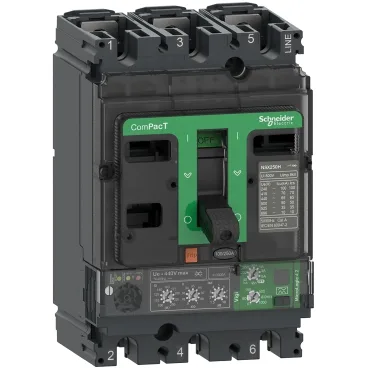
It carries a MicroLogic 4.2 electronic trip unit that covers overload (L), short-time short-circuit with fixed delay (So), instantaneous short-circuit (I), and integrated earth-leakage (R) protection — all in one device. That means a single breaker handles both overcurrent and ground-fault protection, which simplifies panel wiring and saves a slot compared to a separate GFCI module. Breaking capacity is 50 kA Icu at 380/415 V AC and 440 V AC per IEC 60947-2, with 85 kA Icu at 240 V AC per UL 60947-4-1. For a 100 A frame, 50 kA at 415 V gives you solid headroom on most North American and European distribution panels — you won't be chasing fault-current coordination issues on a typical 400 V line feeding motor control centers or lighting panels. It's meant for a clean indoor electrical room, not a washdown zone.
The MicroLogic 4.2 trip unit — what the settings mean for your line
The earth-leakage function is built in, adjustable via the IΔn rotary switch. That 20-minute thermal memory before and after tripping means the breaker remembers a prior overload — if you're resetting after a stall on a conveyor, the trip curve shifts to protect the cable, not just the motor. Category A utilization (no intentional short-time delay for selectivity with downstream breakers) means this breaker trips fast on a short circuit. If you need zone-selective interlocking, you'd step up to a Category B breaker. For a standalone feeder or branch protection, Category A is fine. Electrical durability is 20,000 cycles at 440 V at half rated current, 10,000 cycles at full rated current. That's typical for a molded-case breaker — good for thousands of manual switching operations on a disconnect, but not rated for continuous motor starting duty. Use a contactor for that.