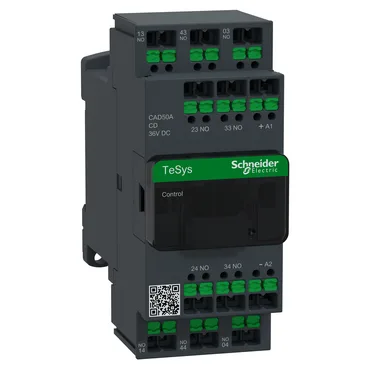
It is designed for control-circuit switching in industrial panels — the 5 NO contact arrangement lets it switch multiple loads or signal paths simultaneously from a single coil command.
The utilisation categories AC-15, AC-14, and DC-13 define the load types this relay can switch. AC-15 covers solenoid-valve and electromagnetic-brake loads above 72 VA; AC-14 covers small electromagnetic loads below 72 VA; DC-13 covers solenoid loads with a DC coil. For a control relay, these categories are the ones that govern real-world switching life — not a generic resistive rating. Rated operational voltage is listed at 10 MOhm, which is the insulation resistance test value, not the working voltage — the description confirms the relay is rated for <=690 V operational. The 36 V DC coil is standard, meaning no add-on rectifier or voltage-conversion module is needed for a 36 V DC control bus. The 5 NO contact composition means all five poles are normally-open, closing when the coil is energised. This is a common configuration for interposing relay banks where you need multiple isolated signal paths to close together. There are no NC poles on this variant. Mechanical robustness is specified at 10 Gn for 11 ms (relay open) and 15 Gn for 11 ms (relay closed) per IEC 60068-2-27, with vibration tolerance of 2 Gn open and 4 Gn closed across 5–300 Hz. That is standard for industrial panel mounting — no special shock-mounting required for most machine-tool or conveyor applications. IP2X front-face protection per VDE 0106 means the front of the relay is finger-safe against accidental contact, but the relay itself is intended for installation inside an enclosure that provides the overall panel IP rating. Storage range is -60 to 80 °C. The TH protective treatment per IEC 60068 means the relay is treated against tropical humidity and corrosion — suitable for non-condensing environments in pulp-and-paper or chemical plants. Standards compliance includes EN/IEC 60947-5-1, UL 60947-5-1, CSA C22.2 No 60947-5-1, GB/T 14048.5, and JIS C8201-5-1. That covers the major global markets — IEC for Europe and Asia, UL/CSA for North America, GB/T for China, JIS for Japan.
The CAD50ACD uses snap-in terminals for fast wiring — no screw-terminal torqueing required. Dimensions are 45 mm wide, 107 mm high, and 93 mm deep. Operating altitude is rated to 3000 m without derating. Above that, air density reduction affects dielectric withstand and cooling — standard for IEC 60947-series components.