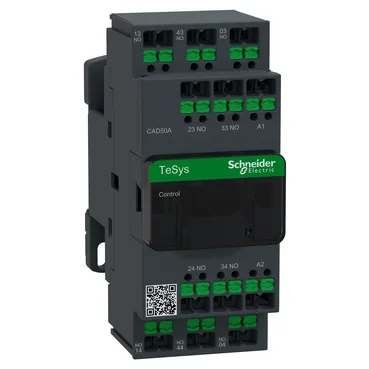
The CAD50AG7 is a TeSys Deca control relay from Schneider Electric, configured with five normally-open (5 NO) pole contacts. It is designed for control-circuit switching in industrial panels, rated for operational voltages up to 690 V with a 120 V AC standard coil. The snap-in terminal design speeds DIN-rail mounting and wiring — a practical detail when you're populating a row of contactors and relays in the same enclosure.
The utilisation categories tell you exactly what loads this relay can handle: AC-15 (solenoid valves, electromagnetic clutches), AC-14 (small inductive loads below 72 VA), and DC-13 (solenoids with DC coils). These are the standard categories per IEC 60947-5-1 for control-circuit devices — so the CAD50AG7 is certified for the full range of pilot-duty switching you'd find in a motor control centre or a conveyor line. The 5 NO contact arrangement gives you five independent switching paths, which is useful when you need to interlock multiple starters or signal separate PLC inputs from one coil. Mechanical robustness is specified with shock and vibration limits: the relay stays closed under 15 Gn shocks (11 ms) and open under 10 Gn, per IEC 60068-2-27. Vibration resistance is 4 Gn closed, 2 Gn open across 5–300 Hz per IEC 60068-2-6. These numbers matter if the panel is mounted on a machine frame or near a large motor — the relay won't chatter or drop out under normal industrial vibration. Storage range extends from -60 to 80 °C. The TH protective treatment per IEC 60068 means the relay is coated against humidity and corrosive atmospheres — relevant for installations in unheated warehouses or near chemical processing areas.
The CAD50AG7 carries approvals under EN/IEC 60947-5-1, UL 60947-5-1, CSA C22.2 No 60947-5-1, GB/T 14048.5, and JIS C8201-5-1. That covers the major global markets — IEC for Europe and much of Asia, UL/CSA for North America, GB/T for China, JIS for Japan. For a procurement desk filling a BOM for a machine headed to multiple regions, this single part number satisfies the certification requirements across all those jurisdictions.