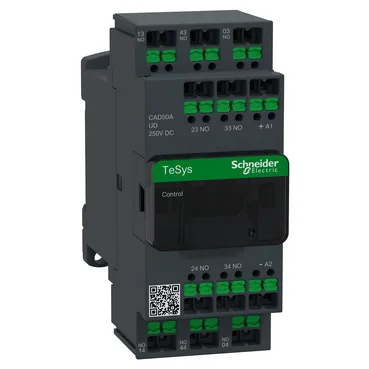
It uses snap-in terminals for wiring and is designed for control circuit applications — switching pilot devices, contactor coils, and signal loads in a panel. It carries certifications across EN/IEC 60947-5-1, UL 60947-5-1, CSA C22.2 No 60947-5-1, GB/T 14048.5, and JIS C8201-5-1, so it is accepted in European, North American, Chinese, and Japanese installations without additional agency review.
The 5 NO contact configuration means this relay switches five independent control circuits simultaneously — common for interlocking multiple contactors or enabling several safety/permissive signals from one command. The utilisation categories (AC-15, AC-14, DC-13) tell you it is rated for switching electromagnetic loads (contactors, solenoids) and resistive/inductive pilot-duty circuits, not power-level motor loads. Operating temperature spans -40 to 60 °C, with derating required above 60 °C up to 70 °C — relevant if the relay sits near a heat source or in a non-ventilated enclosure. Storage range is -60 to 80 °C, which covers most shipping and warehouse conditions. Mechanical robustness is specified: the relay withstands 10 Gn shocks for 11 ms in the open state and 15 Gn closed, plus vibration of 2 Gn (open) and 4 Gn (closed) across 5–300 Hz. That makes it suitable for installation on machinery with moderate vibration — conveyors, compressors, or pump skids — without contact chatter. The IP2X front-face protection (per VDE 0106) means the front is finger-safe — a panel builder can work nearby without accidental contact with live terminals behind the relay.
At 45 mm wide, 107 mm tall, and 93 mm deep, the CAD50AUD occupies a standard DIN-rail footprint. The 45 mm width is three 15 mm modular units — plan your enclosure rail space accordingly. Depth of 93 mm means it fits most 120 mm deep enclosures with clearance for wiring behind the relay. The TH protective treatment (conforming to IEC 60068) means the relay is treated against humidity and tropical conditions — no extra conformal coating needed for most indoor industrial environments.