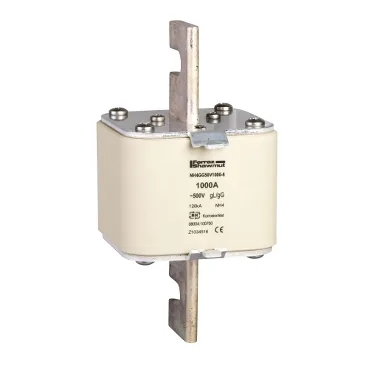
It is a single-piece fuse without striker, intended for protection of high-current power circuits — typically incoming mains or large feeder lines in industrial switchboards and motor control centers. The gG curve means it handles both overload and short-circuit conditions, with a time-current characteristic that coordinates well with downstream motor-starter protection. At 1000 A, this fuse sits at the top end of the NH4 blade range, suited for high-density busbar or bolted connections in a panel.
Sourcing reality — obsolete, but still specifiable
We verify the fuse's physical condition and marking before quoting; the gG curve and NH4 blade dimensions must match the existing holder.
For a feeder circuit, this sets the cable and busbar sizing. The 500 V AC rated operational voltage (Ue) limits the fuse to line-to-line voltages up to 500 V AC — common in 400 V three-phase systems, but not suitable for 690 V or DC circuits without derating. The NH4 blade size is a standardized DIN dimension (blade width ~76 mm, overall length ~200 mm), so the fuse fits any standard NH4 fuse base or switch-disconnector. The gG curve provides full-range protection (overload and short-circuit) and is the most common industrial fuse characteristic, making coordination with upstream and downstream devices straightforward.