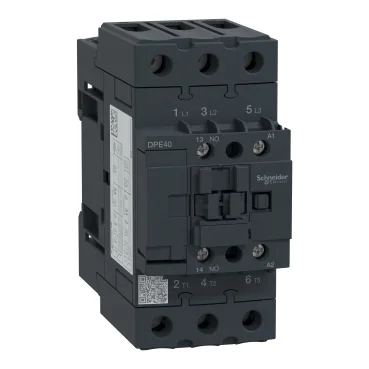
The 40 A figure is the rated operational current (Ie) in AC-3 duty — the category that governs switching of squirrel-cage motors during starting and running. That means it handles a 40 A motor load under the standard IEC 60947-4-1 test profile, not just a resistive heater bank. For resistive loads (AC-1), the same contactor can carry higher current, but the AC-3 rating is the one that decides motor fit. The 120 V AC 50/60 Hz coil matches standard North American control voltages; the coil draws from the signalling circuit, which is rated for 25...400 Hz, so it works on both 50 and 60 Hz supplies without derating. Rated insulation voltage (Ui) is 690 V for the power circuit per IEC 60947-4-1 and 600 V per cUL — so the contactor is suitable for 480 V and 600 V class systems.
The 3-pole block with one normally-open auxiliary contact (1 NO) gives you one feedback or status signal without needing an add-on block. The screw terminals accept power conductors from 2.5 mm² up to 25 mm² (flexible with or without cable end) and control conductors from 1 mm² to 4 mm². Torque the power terminals to 7 N·m for the larger wire range, 5 N·m for the smaller — the control terminals take 1.7 N·m.
Operating altitude is limited to 2000 m; above that, dielectric strength and air clearance derate. The contactor is rated for vibration: 2 Gn open, 4 Gn closed (5...300 Hz), and shock: 10 Gn open, 15 Gn closed (11 ms). That's enough for most industrial machinery but not for extreme mobile or marine applications without additional isolation. Climatic withstand per IACS and IEC 60947-1 Annex Q category D confirms it handles damp heat and cyclic humidity typical of non-condensing environments.
Certified to IEC 60947-4-1 (contactor standard for motor starters), IEC 60947-5-1 (control circuit devices), EN 60947-4-1, EN 60947-5-1, UL 60947-4-1, and CSA C22.2 No 14. That covers the major industrial control standards for North America and Europe. The lifecycle status is Active, so this is a current-production part, not an NRND or obsolete line.