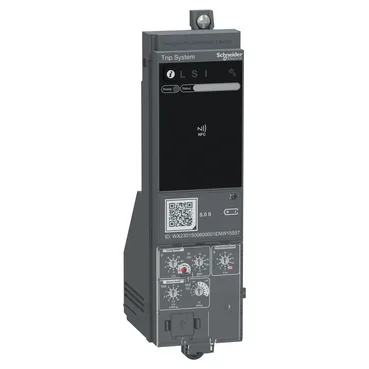
What this Trip System 5.0s control unit does for your breaker
The ENW15557 is the brains for an EasyPact NW air circuit breaker — a micro-processor-based control unit that handles LSI protection (long-time, short-time, instantaneous) for the 630 A to 6300 A trip range. Rated at 690 V AC on 50/60 Hz networks per IEC 60947-2, it's the piece that decides when to hold or when to clear a fault.
What the key settings mean on the route
Long-time pickup (Ir) is adjustable from 0.4 to 1.0 x In, with ten settings — that's your continuous amp rating, what the breaker carries without tripping. Set it for the cable or bus ampacity, not the breaker's max. The long-time delay (Tr) goes from 0.5 to 24 seconds at 6 x Ir, with a 0 to -20% accuracy tolerance. That's your thermal curve; set it long enough to ride through motor starting inrush but short enough to protect the conductor insulation. Short-time pickup (Isd) has ten settings, and the short-time delay (Tsd) is adjustable from 100 to 600 ms. This is your selectivity band — you want the feeder breaker downstream to clear first. Instantaneous pickup (Ii) is adjustable from 2 to 15 x In, also ten settings, with +/- 10% accuracy, and can be turned Off. That's your arc-flash limit; set it high enough to allow transformer inrush but low enough to catch a bolted fault before the arc flash energy climbs. Thermal memory is enabled — so if the breaker sees a series of overloads close together, it remembers the heat buildup from the previous event. That matters for a motor circuit that cycles on and off; without thermal memory, the breaker never accumulates the I²t heat and lets the motor cook.
This control unit mounts fixed drawout into the EasyPact NW breaker cradle — it's not a standalone DIN-rail device. The 77 mm depth, 58 mm width, and 200 mm height fit the standard NW cassette. Neutral position is left; protected poles can be configured as 3D, 3D + N/2, or 4D, with neutral protection settings matching (without protection, 0.5 x Ir, or 1 x Ir). Communication is via NFC (peer-to-peer wireless) and a USB Type-C port — that's how you pull the event logs, alarm logs, and trip logs without opening the panel door. The green/red/orange health status bar and a separate green ready LED give you a quick visual on the state of the unit from across the substation aisle.
The lithium non-rechargeable battery backs up the clock and settings during power-down.