What the 1000 A rating means for your switchgear lineup
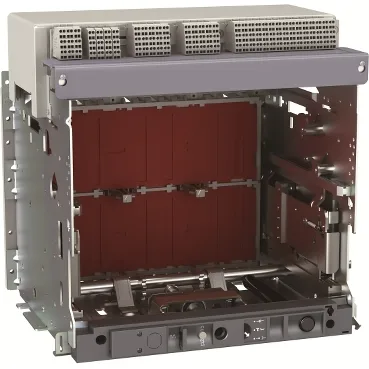
That 1000 A figure is the thermal rating — it governs the busbar and cable sizing upstream, not just the breaker frame. In a typical low-voltage distribution board, this chassis pairs with a drawout circuit breaker of the same frame to handle main incomer or large feeder duty. The 4-pole configuration (4P) covers three-phase plus neutral, so it suits TN-S or TN-C-S systems where the neutral needs isolation or protection. Breaking capacity code N tells you the interrupting rating at the rated voltage — N is a standard level within the EasyPact NW family, typically 50 kA at 415 VAC, though the exact value depends on the specific breaker module paired with this chassis. The chassis itself is the mechanical support and connection point; the interrupting device (the plug-in breaker unit) determines the SCCR. For coordination studies, treat the chassis as the current-carrying path rated to the full 1000 A.
Drawout mounting — what it changes in the panel
Drawout mounting means the breaker unit slides into this chassis on rails, with racking mechanism for connected/test/disconnected positions. That is a maintenance and safety feature: you can isolate the breaker for inspection or swap without unbolting busbars or disturbing the primary connections. The chassis stays wired to the bus; the moving part is the breaker cassette. Panel depth needs to accommodate the racking travel — the chassis itself is 560 mm deep, so factor that into the enclosure size.
Physical fit — dimensions that govern the enclosure cutout
The chassis measures 560 mm deep, 400 mm wide, and 440 mm high. Those are the overall envelope dimensions including the mounting flanges and drawout mechanism. When laying out a switchboard, the width and height determine the compartment size; the depth includes the rear connection space. Allow clearance behind for cable entry and busbar access — the 560 mm is the chassis body, not the total depth with terminations.