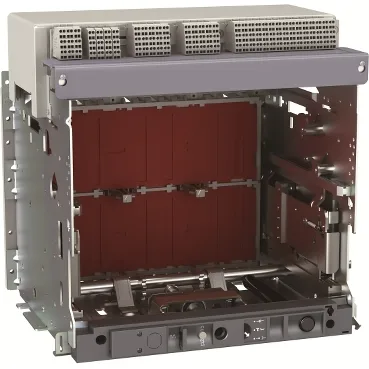
The drawout mounting means the entire moving portion — contacts, arc chutes, mechanism — comes out as a cassette for inspection or swap without breaking the main bus connections. That is the whole point: you pull the cassette, leave the cradle bolted to the switchboard, and get back online faster than a fixed breaker swap.
Above 40 °C you follow the thermal curve in the IEC 60947-2 documentation. The H breaking capacity code tells you the interrupting rating at the rated voltage; it is the high-end option for this frame, sized for installations with higher fault current available upstream. Three poles covers three-phase distribution, typically feeding a main or large feeder breaker in an LV switchboard.
The chassis measures 445 mm deep, 400 mm wide, and 440 mm high. Those are the envelope dimensions for the cradle assembly — the drawout cassette adds a bit of depth when racked out. The 400 mm width fits standard 600 mm wide switchboard cubicles with room for side-mounted busbars or auxiliary compartments. Mounting is drawout, meaning the cradle bolts into the switchboard frame and the moving portion slides in on rails. No crane needed for the cassette; two technicians can handle it.