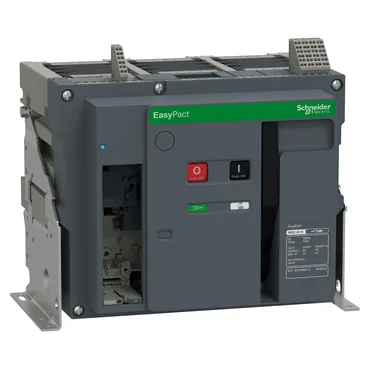
The ENW24111 is a 3-pole EasyPact NW air circuit breaker rated 1250 A at 40 °C — that is the continuous current it carries without tripping in a 40 °C ambient. The 50 kA Icu at 440 V AC means it can safely interrupt a fault current up to 50 kA at that voltage; at 690 V AC the Icu drops to 42 kA. Both figures are per IEC 60947-2, the standard for low-voltage switchgear. The IP40 enclosure keeps out tools and wires over 1 mm but not moisture; mount it in a clean, dry panel or add an enclosure for washdown areas. Rated insulation voltage is 1000 V AC, and impulse withstand voltage is 12 kV — so it holds up to switching surges and lightning-induced spikes common on distribution feeders. The 25 ms maximum breaking time means the breaker clears a fault within two and a half cycles at 60 Hz, limiting arc energy and downstream damage.
Because it is a high-current distribution breaker (1250 A frame), it is a fast mover for plant main switchboards and large motor control centers. Keep one on the shelf if your facility runs at this ampacity; lead times can stretch when demand spikes on the 1250 A frame size.
Fixed mounting on a base plate — no DIN rail. The dimensions are 422 mm wide by 352 mm high by 297 mm deep, so it needs a dedicated cutout in the switchboard or enclosure. Rear connection with a 115 mm pitch without spreader means the bus bars or cable lugs land on the back of the breaker; plan for vertical or horizontal bus orientation. The push-button control type (open/close) is standard for this class — no motor operator included. If remote operation is needed, an optional shunt trip or motor mechanism can be added. The contact position indicator gives a visual confirmation of the main contact state, which helps during racking or maintenance. Electrical durability is 6,000 cycles at 440 V without maintenance, dropping to 4,000 at 690 V. For frequent load switching (daily or hourly), consider a contactor instead.
Certified to IEC 60947-2, the international standard for low-voltage circuit breakers. It is suitable for isolation per that standard — meaning it provides a visible break and meets the isolation distance requirements. The operating temperature range is -5 °C to 60 °C; storage range is -40 °C to 85 °C without the control unit, -25 °C to 85 °C with it.