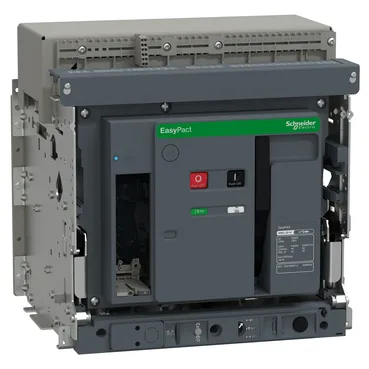
The 66 kA Icu at 220...440 V AC (50/60 Hz) per IEC 60947-2 tells you it can safely interrupt a fault up to that level without blowing apart — that's the short-circuit capacity that governs upstream fuse or breaker coordination. Drawout mounting means the breaker chassis slides out of its cradle for inspection or swap without pulling cables — a standard feature on NW frames that cuts downtime on a faulted unit. Rear connection with a 115 mm pitch without spreader matches the busbar layout on most low-voltage switchgear lineups; verify your horizontal/vertical bus orientation against the connection position. Pollution degree 4 per IEC 60664-1 means the creepage distances are sized for conductive dust or condensation — a real-world fit for cement plants, mining substations, or outdoor containerized switchgear where a PD2 breaker would track over in a year.
Integration into the panel — what the dimensions and mounting tell you
At 441 mm wide × 439 mm high × 395 mm deep, the ENW24135 occupies a standard NW-frame footprint. The drawout cradle needs clearance at the front for the racking mechanism — figure at least 100 mm beyond the escutcheon for the door swing and handle throw. Rear connection at 115 mm pitch lines up with common busbar drilling patterns; if your panel uses a spreader plate, the pitch is wider and you'll need the optional adapter kit. If the enclosure is in a dusty or damp environment, the panel builder needs to seal the door and cable entries; the breaker itself doesn't carry an IP65 gasket.
Selectivity and coordination — the numbers that matter downstream
The 65 kA Icw for 1 s at 440 V means this breaker can pass a short-circuit current for a full second while a downstream device clears — that's the selectivity window. For a 1250 A main feeding 400 A feeders, the Icw gives you time for the feeder breaker to trip before the main sees the full fault energy. The 25 ms maximum breaking time is fast enough to limit let-through energy on a bolted fault, protecting downstream cables and busbars. Category B utilization with 6000 electrical cycles at 440 V without maintenance and 20000 mechanical cycles with maintenance confirms this is a switchgear-grade breaker designed for frequent switching, not a distribution block that gets operated once a year. The 12 kV impulse withstand covers surge coordination for a 690 V system.