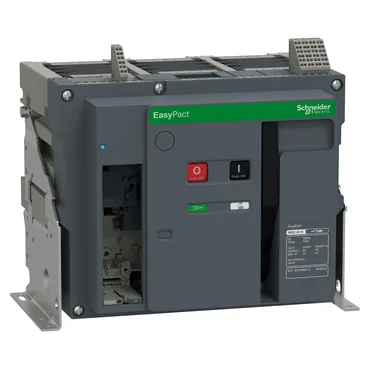
For a distribution main or a large motor control center feeder, that 4000 A frame sets the maximum load you can hang downstream. The 25 ms maximum breaking time and 70 ms maximum closing response time are the mechanical limits for fault interruption and reclosure cycles. The pollution degree 4 rating per IEC 60664-1 means this breaker is built for harsh environments — conductive dust, condensation, heavy contamination. That's a step above the typical industrial pollution degree 3, and it drives the creepage distances and clearances inside the breaker. For a switchyard, a steel mill, or a cement plant, that degree 4 rating is what keeps the insulation from tracking over time.
Deployment context
Mounts fixed to a base plate — no DIN rail, no draw-out cradle. The rear connection position with a 115 mm pitch (without spreader) means the bus bars or cables land directly on the back of the breaker. At 422 mm wide, 352 mm high, and 297 mm deep, this is a panel-mounted frame that needs its own compartment in the switchboard. The push-button control type is manual — no motor operator or remote closing coil in this variant. For a distribution main that sees infrequent switching, that's fine. If the line needs remote reclosing or SCADA control, you'd spec the motor-operated version. The contact position indicator gives a visual open/closed status on the front of the breaker.
The electrical durability is rated at 5000 cycles at 440 V AC without maintenance under Category B, and 2500 cycles at 690 V AC. Mechanical durability is 20000 cycles with maintenance, 10000 without. For a main breaker that may only operate a few times a year, those numbers are generous. For a switching duty application where the breaker cycles daily, the electrical endurance at the operating voltage is the limiting factor — plan maintenance intervals around it.
Designed and tested to IEC 60947-2 for low-voltage switchgear and controlgear. The suitability for isolation marking (per IEC 60947-2) means this breaker can be used as a disconnecting means — no separate disconnect switch needed upstream. Storage range is -40 to 85 °C without the control unit, or -25 to 85 °C with it.