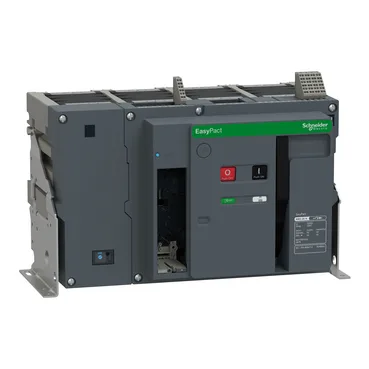
What the 4000 A and 66 kA ratings mean for your main distribution
Its breaking capacity hits 66 kA Icu at 220...440 V AC and 50 kA Icu at 690 V AC, both per IEC 60947-2. The 66 kA figure governs fault interruption at typical low-voltage distribution voltages (400/480 V); the 50 kA at 690 V covers higher-voltage industrial networks. Category B utilization means it's fully selective with downstream breakers — a fault on a branch won't take the main offline, which is the whole point of a tiered distribution design. Pollution degree 4 per IEC 60664-1 is the harshest industrial classification — conductive dust, condensation, or heavy contamination. That rating tells you the creepage distances and insulation coordination are built for dirty environments: cement plants, steel mills, mining substations. IP40 keeps tools and fingers out but isn't sealed against moisture; the breaker belongs in a clean, dry enclosure or switchgear lineup.
Mechanical durability: 20,000 cycles with maintenance, 10,000 without. Electrical durability at rated voltage: 5,000 cycles at 440 V, 2,500 at 690 V without maintenance, both per IEC 60947-2. For a main breaker that operates infrequently (maybe a few dozen operations a year), these numbers are effectively life-of-installation. The 25 ms maximum breaking time and 70 ms maximum closing response are the electromechanical limits — the arc chute and contact system clear the fault in under three cycles at 50 Hz.