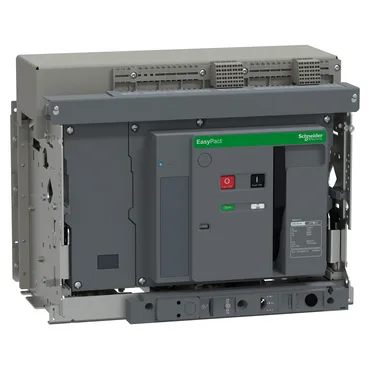
Switch disconnector for high-current distribution
The AC-23A rating means it can make and break currents several times the rated operational current, which is what you need when a motor start or a transformer inrush hits the contacts. It is a 4-pole drawout unit, so the switching body withdraws from the cradle for safe inspection or replacement without unbolting the main bus connections. This part is built for distribution panels where the main incomer or a large feeder must be isolated visibly and safely. It is certified as suitable for isolation per IEC 60947-3, meaning the open gap is guaranteed to protect personnel working downstream. The drawout mechanism mates with a fixed cradle on a rail support; connection pitch is 115 mm without a spreader, so the busbar layout needs that spacing.
Fault-handling capability and coordination
The ENW24220 carries a breaking capacity code of HA. Its rated short-time withstand current (Icw) is 66 kA for 1 second or 36 kA for 3 seconds, both at ambient temperatures up to 70 °C. That tells you the switch can ride through a downstream fault long enough for an upstream breaker or fuse to clear — essential for selective coordination in a main-tie-main or a large motor control centre. The rated short-circuit making capacity (Icm) is 143 kA peak at 50/60 Hz, which means the contacts can close onto an existing fault without welding shut. Rated impulse withstand voltage (Uimp) is 12 kV, and the insulation voltage (Ui) is 1000 V AC. Pollution degree 4 per IEC 60664-1 is specified — that is the heavy industrial environment where conductive dust or condensation can be present, so creepage distances are already accounted for in the design.