What the 2500 A and 50 kA ratings mean for your distribution board
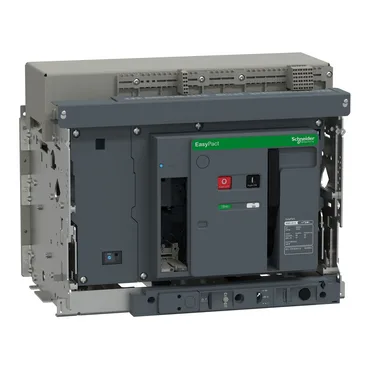
For a main incomer or bus-tie in a low-voltage switchboard, that rating covers a 2500 A transformer secondary or a large motor control center feed. Its breaking capacity is 50 kA Icu at 220...440 V AC 50/60 Hz per IEC 60947-2. At 690 V AC the Icu drops to 42 kA, so verify your system's prospective short-circuit current at that voltage level before specifying. The 4-pole (4P) configuration with neutral on the right handles three-phase plus neutral distribution. Drawout mounting means the breaker chassis stays wired to the bus while the moving portion pulls out for maintenance or swap — no need to disconnect power cables. Rear vertical and horizontal connection positions give panel builders flexibility in busbar layout.
Lifecycle and sourcing — active production, quoted to order
Integration into a switchboard — drawout frame dimensions and clearances
The push-button control provides local open/close without needing a separate control panel. A contact position indicator gives visual confirmation of the main contact state, useful during racking in or out.
Electrical durability and isolation — what the ratings guarantee for maintenance planning
Category B utilization means the breaker is designed for selectivity — it can be coordinated with downstream devices so that only the faulted branch opens. Electrical durability is 5000 cycles at 440 V AC without maintenance, and mechanical durability is 20000 cycles with maintenance or 10000 without. For a main breaker cycled a few times per year, that translates to decades of service before contact replacement is needed. That means it can serve as the disconnecting point for a circuit, with a visible gap between contacts when open. Maximum breaking time is 25 ms, and maximum closing response time is 70 ms — fast enough for most distribution protection schemes.