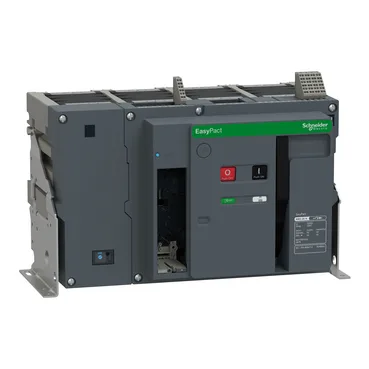
Its breaking capacity hits 55 kA Icu at 220...440 V AC, 50/60 Hz per IEC 60947-2, meaning it can safely interrupt a fault current up to 55 kA at those voltages without welding its contacts or exploding — critical for a high-fault installation like a transformer secondary or a generator tie. Rated insulation voltage is 1000 V AC, and impulse withstand is 12 kV — that covers most industrial installations where voltage spikes from lightning or switching transients are a concern. This is a Category B breaker (IEC 60947-2), which means it's designed for distribution duty with selective coordination — it can hold in during a downstream fault to let a branch breaker clear first, avoiding a full plant blackout.
Mounting and physical integration
Fixed-mount design on a base plate, so it bolts into a switchboard or a dedicated enclosure — no DIN-rail option on this size; you're building a panel around it. Dimensions: 537 mm wide, 352 mm tall, 297 mm deep — that depth (297 mm) is the front-to-back space needed behind the panel door, so check your enclosure depth before cutting openings. Rear connections with a 115 mm pitch (without spreader) — the bus bars or cables land on the back, not the front, which keeps the front clean for the push-button controls and the contact position indicator.
The ENW24244 is listed as current production — still an active catalog item from Schneider Electric, not a phase-out or obsolete part. It's part of the EasyPact NW family, which is the successor to the earlier Masterpact NW range; the form factor and ratings carry forward, so if you're replacing an old Masterpact NW, this is the direct drop-in.
Designed and tested to IEC 60947-2, the international standard for low-voltage circuit breakers — covers thermal, magnetic, and short-circuit performance. Pollution degree 4 per IEC 60664-1 — that's the highest pollution severity (conductive dust, condensation), so it's suited for harsh industrial environments like cement plants or foundries. Operating temperature range -5 to 60 °C; storage from -40 to 85 °C (without control unit) — covers most indoor installations, but if your switchroom hits above 60 °C, you'll need to derate the 4000 A rating.