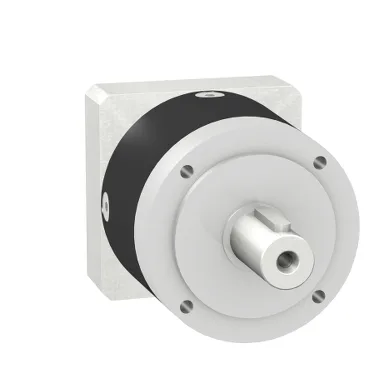
Planetary gearbox for precision motion — 8:1 reduction, 6 N.m continuous, 96 % efficiency
The GBX0400080401D is a 40 mm-diameter planetary gearbox from Schneider Electric's GBX series, offering an 8:1 reduction ratio with straight-cut teeth. It delivers 6 N.m continuous output torque and peaks at 10 N.m maximum — sized for servo or stepper motor stages where compactness and low backlash (30 arc.min maximum) matter. Rated efficiency of 96 % means only 4 % of input power is lost as heat in the gear train — relevant for duty-cycle applications where thermal buildup in a confined cabinet is a concern. Noise level is 55 dB at 1 m, no-load, quiet enough for lab or light-industrial environments.
Service life and environmental limits — what a maintenance spare buyer needs to know
Rated service life is 30 000 hours at 100 rpm and 30 °C ambient — a common benchmark for continuous-duty gearboxes in packaging or material-handling axes. The gearbox is lubricated for life — no oil-change intervals to schedule. Shaft output IP54 protection means it resists dust ingress and splashing water, but not washdown; keep it out of direct hose spray. Housing is black anodised aluminium; shaft material is C 45 steel.
Mechanical load limits — axial force, radial force, and torsional rigidity
Maximum axial force Fa is 200 N at 100 rpm for a 10 000-hour life, derating to 160 N for the full 30 000-hour rating. Maximum radial force Fr follows the same pattern: 200 N at 100 rpm for 10 000 hours, 160 N for 30 000 hours, with the force applied at mid-distance from the output shaft. These are the limits that govern bearing life in overhung-load applications like belt drives or pinion gears. Torsional rigidity is 1 N.m/arcmin — a measure of how much the output shaft twists under load. Combined with 30 arc.min maximum backlash, this gearbox suits positioning axes where repeatability matters more than absolute accuracy; for sub-arcmin applications, look at a low-backlash or harmonic-drive stage. Moment of inertia is 0.017 g.cm² — low enough that it does not dominate the reflected inertia of a small servo motor. Mounting position is any, simplifying integration into vertical or inverted orientations.