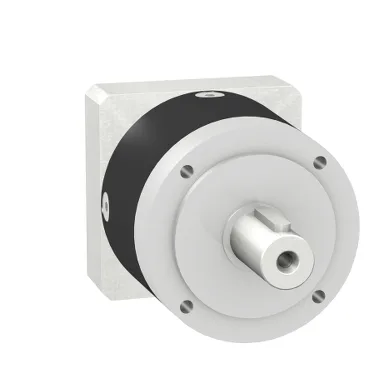
Lifecycle reality — obsolete, sourced through independent channels
Schneider Electric has marked the GBX0400081401F as obsolete. This part is sourced through independent distribution channels — quantities are confirmed at RFQ against the BOM line.
Torque, ratio, and backlash — the three numbers that decide fit
The 8:1 reduction ratio is the primary speed-reduction parameter — a motor running at 3000 rpm on the input sees 375 rpm at the output shaft. The continuous output torque is 6 N.m (53.1 lbf.in) at 100 rpm and 30 °C; this is the working limit for steady-state duty, not the peak or emergency rating. Maximum torsional backlash is 30 arc.min — roughly 0.5 degrees of rotational play under reversing load. For positioning applications that need better than half-degree repeatability, this gearbox needs a preloaded or low-backlash alternative. The maximum output torque is 10 N.m (88.5 lbf.in) at the same speed and temperature — this is the peak overload ceiling, not a continuous rating. Exceeding 6 N.m continuously accelerates wear toward the 30000-hour service life target.
Efficiency, noise, and thermal envelope
Rated 94 % efficiency — about 6 % of input power is lost as heat inside the gearbox housing. For a 100 W motor input, that is 6 W of heat to dissipate through the black anodized aluminium housing (40 mm diameter). No external cooling is needed at this power level, but the housing surface temperature will rise above ambient by roughly 10–15 °C under full load. Noise level is 55 dB at 1 m, no-load — roughly the sound of a quiet office. Under load the noise rises; the straight-tooth gear cut (not helical) means the mesh is inherently noisier than a helical gearbox of the same ratio. The gearbox is lubricated for life — no oil-change interval, no fill port. The shaft output seal is rated IP54, meaning it resists dust ingress and water splashes but is not rated for pressurized washdown or submersion.
Shaft loading limits — axial and radial force budgets
Maximum axial force (Fa) is 200 N for a 10000-hour service life at 100 rpm and 30 °C, dropping to 160 N for the full 30000-hour target. These limits apply to thrust loads along the output shaft axis — overloading the shaft in tension or compression shortens bearing life. Maximum radial force (Fr) follows the same pattern: 200 N for 10000 hours, 160 N for 30000 hours, with the force applied at mid-distance from the output shaft. Radial loads come from belt drives, chain sprockets, or direct-coupled misalignment — exceeding the limit bends the shaft or collapses the output bearing. The shaft material is C45 carbon steel — standard medium-carbon grade with good strength but no corrosion resistance. In humid or washdown environments, the exposed shaft end needs a protective coating or stainless alternative.