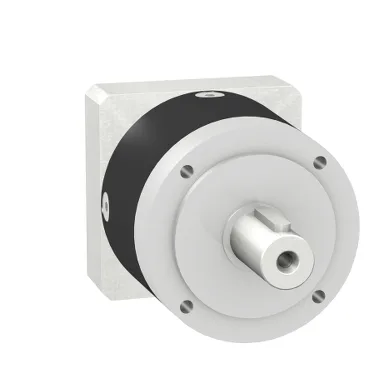
Active production — no obsolescence risk for the BOM line
The GBX0400090403D carries an Active product status from Schneider Electric, so there is no end-of-life clock ticking on this order code. For a BOM freeze or a multi-year production run, this gearbox can be specified without planning a last-time-buy or a substitute qualification.
9:1 reduction and 26 N.m — sizing the driven load
The 9:1 ratio drops the input speed by a factor of nine while multiplying torque. With a maximum output torque of 26 N.m, this gearbox handles indexing tables, small conveyors, or positioning axes where the load torque at the output shaft stays under that ceiling. The 94 % efficiency means about 6 % of the input power is lost as heat — relevant for the thermal budget in a sealed enclosure. The straight-tooth spur gear set is noisier than a helical equivalent but generates no axial thrust, so the output bearings see only radial and axial loads from the application, not from the gear mesh. At 55 dB at 1 m no-load, the acoustic level is low enough for most production-floor environments; the operator will hear it but it won't dominate the noise floor.
Mounting, sealing, and service life
The gearbox can be mounted in any position — no oil-level orientation to worry about. The IP54 rating at the shaft output means it resists splashing water and dust ingress, but it is not rated for washdown; keep direct coolant or pressure-spray away from the shaft seal. The housing is black anodized aluminium, 40 mm diameter, which fits standard mounting clamps and brackets. Service life is specified at 30000 hours at 100 rpm and 30 °C ambient. At higher speeds or temperatures, the life derates. The gearbox is lubricated for life — no maintenance grease changes required. The maximum radial force at the output shaft is 200 N at 100 rpm for a 10000-hour life, or 160 N for the full 30000-hour life; a belt or pulley load must be sized within these limits to avoid premature bearing failure.
Backlash and torsional rigidity — positioning accuracy
Maximum torsional backlash is 35 arc.min — this is the lost motion between input and output when the direction reverses. For simple speed reduction or constant-direction loads, backlash is irrelevant; for servo positioning or bidirectional indexing, the 35 arc.min window must be within the system's accuracy budget. Torsional rigidity is 1.1 N.m/arcmin, which means the shaft winds up about 0.9 arcmin per N.m of load torque — a factor in servo tuning if the application is stiff.