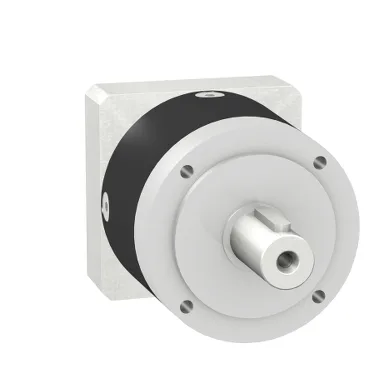
Planetary gearbox, 12:1 ratio — torque density in a 40 mm package
The GBX0400120403D is a straight-tooth planetary gearbox from Schneider Electric's GBX series, delivering a 12:1 reduction ratio in a 40 mm diameter housing. That 94% efficiency means under 6% of the input power is lost as heat — relevant when the motor is sized close to the load, especially in a duty cycle where the gearbox runs near its 32 N.m maximum output torque. Planetary construction packs the torque capacity of a larger parallel-shaft unit into a compact cylindrical envelope. For a 40 mm frame, 32 N.m at the output shaft is a solid figure — it handles indexing tables, small conveyors, and positioning axes where space behind the motor is tight.
Rated life, lubrication, and load limits — what 30000 hours means for the BOM
The service life is specified at 30000 hours at 100 rpm output speed and 30 °C ambient. That rating assumes the gearbox is loaded to the published axial and radial force limits — 160 N axial (Fa) and 200 N radial (Fr) at 100 rpm, both measured at mid-span on the output shaft. Run the gearbox faster or hotter and the life derates; run it slower and the bearing and gear wear extend proportionally. The unit ships lubricated for life — no oil change interval to schedule, no breather or drain plug on the housing. This simplifies installation in hard-to-access locations, but it also means the gearbox is sealed; if the seal is compromised by shaft loading or washdown, the lubricant loss is permanent.
IP54 shaft output and aluminium housing — survives the dusty, damp enclosure
The shaft output carries an IP54 ingress rating — dust-protected and splash-resistant. That is not washdown-rated (IP65 or higher), but it is adequate for control cabinets, conveyor drives in dry processing areas, and any installation where the gearbox is not directly hosed down. The black anodized aluminium housing resists corrosion in humid environments better than painted steel, and the anodized layer adds surface hardness against incidental contact. Mounting position is unrestricted — the gearbox can be oriented shaft-up, shaft-down, or horizontal. This flexibility simplifies integration into existing machine layouts where the motor axis must point in a specific direction. The 40 mm external diameter means it fits through standard cable gland openings and into tight corners of a panel or machine frame. Ambient temperature range spans -25 °C to 90 °C. The lower bound covers cold storage or outdoor winter startup; the upper bound is within the range of a motor-mounted gearbox near a running drive. Above 90 °C the lubricant viscosity drops and the seal life shortens — the 30000-hour life figure is anchored at 30 °C.
Backlash, stiffness, and inertia — positioning loop parameters
Maximum torsional backlash is 35 arc-minutes — a standard-precision planetary stage, not a zero-backlash unit. For point-to-point positioning where the load settles against the same gear flank each cycle, 35 arc-min is acceptable; for bidirectional reversing applications (lead screw drives, indexing with direction changes) the lost motion shows up as a dead band that the controller must compensate or the position tolerance must absorb. Torsional rigidity is 1.1 N.m per arc-minute of windup. This stiffness figure, combined with the 0.029 g.cm² moment of inertia reflected to the input, means the gearbox does not add significant compliance or inertia to the servo loop — the motor sees mostly the load inertia. The low inertia is a direct benefit of the 40 mm planetary design; larger frame gearboxes carry higher reflected inertia and slow the acceleration profile. Noise level is 55 dB at 1 m under no-load conditions. Straight-cut teeth are inherently noisier than helical at higher speeds, but at 100 rpm output (1200 rpm input for 12:1) the gear mesh frequency is low enough that 55 dB is unobtrusive. In a control cabinet with cooling fans, the fans will dominate the acoustic signature.