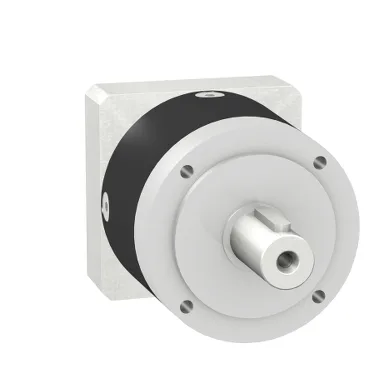
18 N.m continuous, 29 N.m peak — what that means for motor sizing
The GBX0400150401D: The continuous output torque is 18 N.m; that's the number to size the motor against for steady-state conveying or indexing. The maximum output torque of 29 N.m covers short overload peaks — starts, stalls, or momentary jams — but the drive train sees the 18 N.m limit in normal cycling. At 94% efficiency, about 6% of the input power goes into heat inside the gearbox. For a continuous 18 N.m output at 100 rpm, that's roughly 12 W of heat — the black anodized aluminium housing sinks it without a fan, but the 30 °C ambient rating means the gearbox shouldn't sit in a hot cabinet or next a motor running hot.
30,000-hour service life — lubed for life, no re-grease port
The service life is 30,000 hours at 100 rpm and 30 °C — that's about 3.4 years of 24/7 operation before the gearbox should be replaced. It's lubricated for life with no re-grease access, so the 30,000-hour mark is the replace-at interval, not a lube interval. The radial and axial force ratings drop when you stretch the life: at 30,000 hours the maximum radial force is 160 N at 100 rpm, versus 200 N if you accept a 10,000-hour life. If the application loads the shaft bearings hard, the shorter-life rating gives more margin.
15:1 straight-tooth planetary — 35 arc-min backlash
Straight-tooth planetary with 15:1 reduction and 35 arc-minutes maximum torsional backlash. That's standard precision — fine for positioning conveyors, rotary tables, or pick-and-place where the load doesn't reverse direction rapidly. For zero-backlash servo axes (machining, laser cutting), this gearbox will show lost motion at each reversal. The torsional rigidity is 1.1 N.m per arc-minute of windup — under the 18 N.m continuous load the shaft twists about 16 arc-minutes before the output moves. That windup is predictable and repeatable, so the controller can compensate if the application needs tighter positioning.