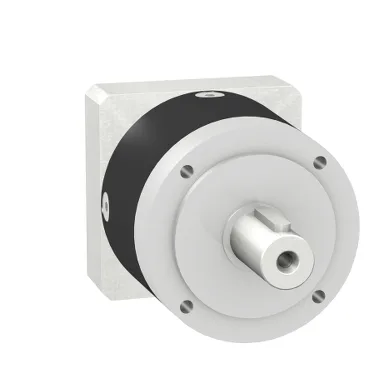
15:1 planetary reduction in a 40 mm frame
The GBX0400151404F is a straight-tooth planetary gearbox from Schneider Electric's GBX series, delivering a 15:1 reduction ratio in a 40 mm diameter package. Its continuous output torque is 18 N.m at 100 rpm and 30 °C, with a maximum intermittent torque of 29 N.m under the same conditions. Rated service life is 30,000 hours at the continuous torque rating — a figure that drops to 10,000 hours at the maximum torque limit. The gearbox is lubricated for life, eliminating periodic oil changes in service.
Load ratings and application limits
Maximum axial force Fa is 200 N at 100 rpm for a 10,000-hour life, derating to 160 N for the full 30,000-hour service interval. Maximum radial force Fr follows the same pattern: 200 N at mid-shaft for 10,000 hours, 160 N for 30,000 hours. Torsional backlash is 28 arc.min maximum — this is the angular play between input and output when reversing direction. For positioning applications requiring tighter repeatability, a lower-backlash gearbox would be needed. Efficiency is 94 %, meaning 6 % of input power is lost as heat in the gear train. At 18 N.m output and 100 rpm, the thermal dissipation is roughly 12 W — well within the anodized aluminium housing's natural convection capability across the -25 to 90 °C operating range. Noise level is 55 dB at 1 m under no-load conditions — comparable to a quiet office environment. Under load, expect a modest increase depending on torque and speed.
Obsolete — sourcing through independent channels
Schneider Electric lists the GBX0400151404F as obsolete. Available through independent distribution — quantities are confirmed at RFQ against the specific BOM line. The gearbox is sourced from surplus and overstock inventory, not factory-direct production.
Mounting and integration notes
The 40 mm diameter housing with black anodized aluminium construction suits compact machine frames and servo-motor mounting flanges. Shaft material is C45 carbon steel, and the shaft output carries an IP54 rating — protected against dust ingress and splashing water, but not submersion. The straight-tooth design is inherently noisier than helical but offers higher efficiency at a given ratio and lower manufacturing cost. For noise-sensitive environments, verify the 55 dB no-load spec against the application's acoustic limits.