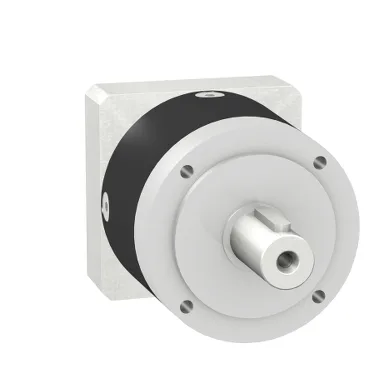
Planetary gearbox for precision motion
The GBX0400160401D is a 40 mm-diameter planetary gearbox from Schneider Electric's GBX series, offering a 16:1 reduction ratio with straight-cut teeth. It delivers 20 N.m continuous output torque and peaks at 32 N.m maximum, making it suited for servo-driven positioning axes in packaging, labelling, and pick-and-place machinery.
Torque, backlash, and service life
Continuous torque is 20 N.m, with a maximum of 32 N.m — the margin above continuous covers acceleration peaks without oversizing the gearbox. Torsional backlash is 35 arc.min maximum, which is standard for a commercial planetary stage; if your application demands sub-arcmin positioning, this gearbox is not the fit. Rated service life is 30,000 hours at 100 rpm and 30 °C ambient, lubricated for life — no maintenance schedule for re-greasing. The 94 % efficiency means only 6 % of input power is lost as heat, which keeps the housing temperature rise manageable even in continuous duty. Maximum radial force at the output shaft is 200 N at 100 rpm for a 10,000-hour life, derating to 160 N for the full 30,000-hour window. Axial force follows the same profile: 200 N at 100 rpm for 10,000 hours, 160 N for 30,000 hours. These limits apply with the force applied at mid-distance on the shaft.
Mounting and environmental fit
The gearbox mounts in any position, with a 40 mm external diameter and black anodized aluminium housing. Shaft output is IP54 — protected against dust ingress and splashing water, but not immersion or high-pressure washdown. The C45 steel output shaft handles the torque without surface hardening for standard industrial environments. The moment of inertia is 0.022 g.cm² — low enough that the servo loop won't need aggressive gain tuning to stabilise the reflected inertia. Noise level is 55 dB at 1 m under no-load conditions — quieter than a typical office printer, so it won't dominate the acoustic profile of a machine cell. The straight-tooth design is inherently noisier than helical, but at this size and speed the difference is marginal.