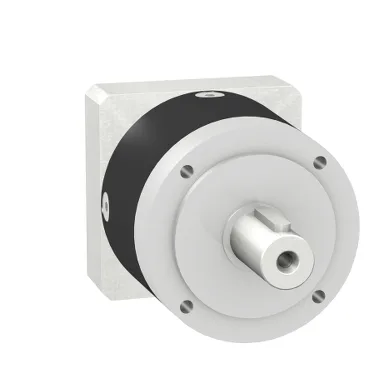
16:1 reduction, 32 N.m — sizing the GBX0400160403D for the load
The 16:1 reduction ratio drops the input speed by a factor of 16 while multiplying torque by roughly the same factor, minus the 94 % efficiency loss. That efficiency figure is typical for a single-stage planetary — the straight-tooth design keeps the mesh losses low but trades off some smoothness against a helical profile. Maximum output torque is 32 N.m, and the torsional rigidity is 1.1 N.m/arcmin — meaning the gearbox twists about 0.9 arcmin under full rated torque. For positioning applications that need better than 1 arcmin repeatability, the 35 arc.min maximum backlash is the number to budget in the system error stack. The 40 mm outer diameter and black anodized aluminium housing make this a compact, corrosion-resistant package for servo or stepper motor integration on a DIN-rail or bracket mount. Shaft output is IP54 — fine for dry indoor cabinets but not for washdown zones.
The gearbox is lubricated for life — no oil-change interval to schedule. Service life is rated 30,000 hours at 100 rpm output speed and 30 °C ambient. If the application runs at higher speed or temperature, derate the life accordingly; the 30,000-hour figure assumes continuous operation at those conditions.
Mounting and integration — what fits where
Mounting position is any position — no oil-level restriction, so the gearbox can be installed shaft-up, shaft-down, or horizontally without a breather or vent relocation. The C 45 steel shaft is standard induction-hardened medium-carbon steel, suitable for keyed or clamping couplings. Maximum radial force Fr is 200 N at 100 rpm applied at mid-shaft, rated for 10,000 hours; for the full 30,000-hour life, the radial limit drops to 160 N. Maximum axial force Fa is 160 N at 100 rpm over 30,000 hours. These limits govern the coupling selection — an overhung load from a belt or gear will eat into the radial budget. Noise level is 55 dB at 1 m, no-load — quiet enough for a lab or office-adjacent machine, but under load the straight-tooth mesh will add a few dB. The moment of inertia reflected to the input is 0.022 g.cm², negligible for most servo tuning loops.