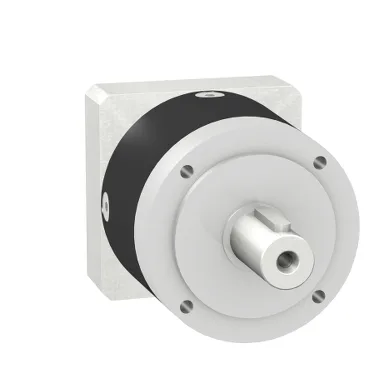
What this 16:1 planetary gearbox delivers — and where it stops
The GBX0400160701F is a 40 mm diameter planetary gearbox with straight teeth and a 16:1 reduction ratio, delivering 20 N.m continuous output torque at 100 rpm (30 °C ambient) and a peak of 32 N.m under the same conditions. Efficiency sits at 94 %, which means about 6 % of input power dissipates as heat inside the housing — relevant for thermal modelling in continuous-duty indexing or conveyor applications where the gearbox runs near its rated torque for extended periods. Maximum torsional backlash is 28 arc.min — this is a commercial-grade positioning figure, not a zero-backlash servo-gearbox. If your application indexes to a repeatable stop and holds, this works; for bidirectional reversing with tight positional accuracy, the accumulated backlash across the train will show up as lost motion.
Load ratings and service life — what the numbers mean for sizing
Rated service life is 30,000 hours at 100 rpm and 30 °C ambient — that is about 3.4 years of continuous operation. The gearbox is lubricated for life, so no maintenance interval for grease changes; the life limit is bearing and gear wear, not lubrication degradation. Maximum radial force (Fr) on the output shaft is 200 N for a 10,000-hour life target, dropping to 160 N if you need the full 30,000-hour service life — both measured with the load applied at mid-distance from the shaft shoulder. Axial force (Fa) follows the same derating curve: 200 N for 10,000 hours, 160 N for 30,000 hours. Shaft output seal is rated IP54 — protected against dust ingress and splashing water, but not submersion or high-pressure washdown. The housing is black anodized aluminium; the shaft is C45 carbon steel.
Obsolete — sourcing through independent channels
Available through independent surplus and broker channels — quantities are lot-specific and confirmed at RFQ.
Noise and thermal limits for integration
Noise level is 55 dB at 1 m, no-load — this is audible in a quiet lab or office environment but typically masked in a production hall with motors, pumps, and conveyors running. The straight-tooth gear cut contributes more whine than helical gearing; if acoustic signature matters, a helical planetary would be quieter at the same ratio.