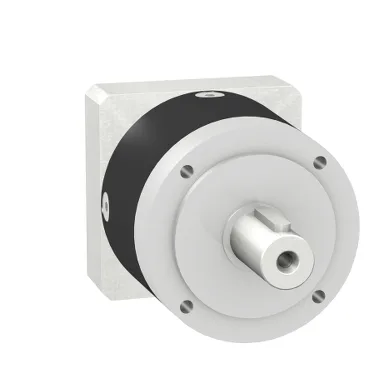
20:1 reduction, 32 N·m peak — what the torque ratings mean
The GBX0400200704F is a 40 mm-diameter planetary gearbox with a 20:1 reduction ratio, straight-cut teeth, and a black anodized aluminium housing. Maximum output torque is 32 N·m at 100 rpm and 30 °C ambient — this is the peak intermittent rating, not the continuous duty point. Continuous output torque is 20 N·m at the same speed and temperature — the figure that governs steady-state operation in a conveyor, indexing table, or positioning axis. Exceeding 20 N·m continuously accelerates wear and reduces the 30,000-hour service life at rated conditions.
Backlash, efficiency, and the straight-tooth trade-off
Maximum torsional backlash is 28 arc-minutes — a standard-precision grade for straight-tooth planetary gearboxes. This is adequate for general motion control and simple positioning, but not for high-accuracy indexing or servo axes where sub-arc-minute backlash is needed. Efficiency is listed at 94 %, which is typical for a single-stage straight-tooth planetary at full load. Straight teeth are inherently noisier than helical — the noise level is 55 dB at 1 m, no-load — but they avoid the axial thrust loads that helical gears generate, simplifying bearing selection in the driven assembly.
Force limits and service life — derating for real loads
Maximum radial force on the output shaft is 200 N at 100 rpm for a 10,000-hour life, or 160 N for 30,000 hours — force measured at mid-span of the shaft extension. Axial force limits are identical: 200 N for 10,000 hours, 160 N for 30,000 hours. These are the constraints that govern overhung load capacity from pulleys, sprockets, or direct-coupled loads. The gearbox is lubricated for life — no oil-change interval — and operates from -25 °C to 90 °C ambient. Shaft output sealing is IP54, meaning dust-protected and splash-resistant, suitable for indoor industrial environments but not washdown.
Obsolete — sourcing through independent channels
Schneider Electric lists the GBX0400200704F as obsolete. No official successor or pin-compatible replacement is recorded from the manufacturer. The part is available through independent surplus and broker channels — quantities are lot-specific and confirmed at RFQ.