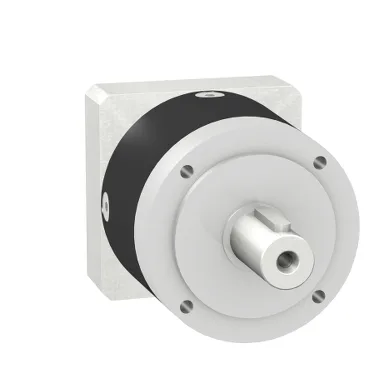
What the torque ratings mean for your axis
The GBX0600031402F is a 60 mm planetary gearbox with a 3:1 reduction ratio, delivering 28 N.m continuous output torque at 100 rpm and a peak of 45 N.m under the same conditions. That 28 N.m continuous figure at 30 °C ambient is the number to size against — the peak rating is for intermittent acceleration or shock loads, not steady-state duty cycles. The 94 % efficiency means 6 % of input power is lost as heat through the gear train, which is typical for a single-stage planetary — relevant when sizing the upstream motor for thermal margin.
Load limits and service life at 100 rpm
Rated service life is 30,000 hours at 100 rpm and 30 °C — at that speed the maximum axial force is 450 N and maximum radial force is 340 N applied at mid-shaft. Push to 10,000 hours and the axial and radial limits increase to 600 N and 500 N respectively — useful for short-life applications where you trade longevity for higher load capacity. The 16 arcmin maximum torsional backlash is the total angular play across the gear train — for a positioning axis this determines the minimum repeatable move, not the absolute accuracy.
Sourcing an obsolete planetary gearbox
The spread is the business here: this part moves through independent surplus channels, not the factory line. The 60 mm planetary form factor with 3:1 ratio is common across several manufacturers — if a board spin or adapter flange is an option, a parametric search on continuous torque (28 N.m) and backlash (≤16 arcmin) will surface functional equivalents.
Mounting and environmental fit
Shaft output is rated IP54 — splash-resistant but not washdown-rated, so keep it out of direct hose spray or install a shaft seal boot in wet environments.