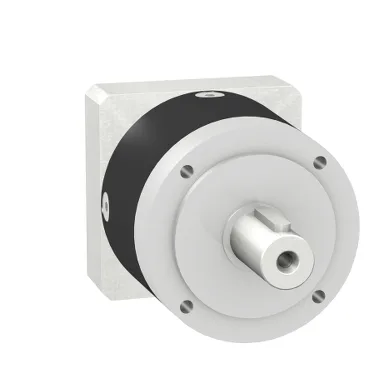
The GBX0600040854G is a 60 mm-diameter planetary gearbox with a 4:1 reduction ratio, straight-cut teeth, and a black anodised aluminium housing. It delivers a continuous output torque of 38 N.m at 100 rpm and a maximum output torque of 61 N.m at 100 rpm, both rated at 30 °C ambient. The service life is 30000 hours at 100 rpm and 30 °C — this is the L10 life under the rated load, not a shelf-life limit. The gearbox is lubricated for life, so no maintenance interval for grease changes. Torsional rigidity is 2.3 N.m/arcmin, with a maximum torsional backlash of 16 arc.min. For a positioning axis, that backlash figure governs the repeatability floor — if the application requires less than 16 arc.min of lost motion at reversal, this gearbox is not the right fit.
Sourcing reality — obsolete, quoted to order
Schneider Electric lists the GBX0600040854G as obsolete. Available through independent surplus and broker channels. No stock-holding claim is made here.
Mechanical interface and environmental limits
The output shaft is C 45 steel. Maximum axial force (Fa) is 450 N at 100 rpm for the 30000-hour life target, or 600 N for a 10000-hour life. Maximum radial force (Fr) applied at mid-distance from the output shaft is 340 N for 30000 hours, or 500 N for 10000 hours. Ambient temperature range for operation is -25 to 90 °C. The shaft output seal carries IP54 protection — splash-resistant but not hose-down rated. The gearbox can be mounted in any position. Moment of inertia reflected to the input is 0.093 g.cm², which is low enough that the servo or stepper tuning should not be dominated by the gearbox inertia in most small-axis builds.
Efficiency and noise — what 96 % and 58 dB actually mean on a line
Rated efficiency is 96 % — this is the mechanical power transfer efficiency at rated load and speed. The 4 % loss is dissipated as heat within the housing; for a 38 N.m continuous output at 100 rpm (~398 W mechanical output), the heat rejection is about 16 W, which the black anodised aluminium housing sheds without forced cooling in most panel environments. Noise level is 58 dB at 1 m, no-load. Straight-cut teeth are inherently noisier than helical at higher speeds, but at 100 rpm output (400 rpm input with the 4:1 ratio) the gear whine is well below typical industrial background noise. If the application runs above 1500 rpm input, expect the noise floor to rise.