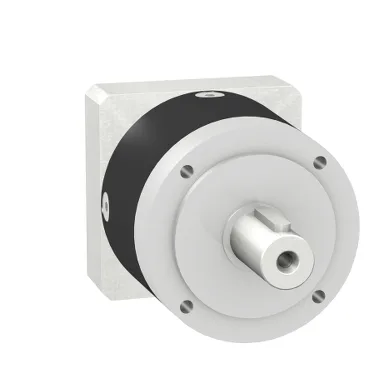
Planetary gearbox, 60 mm, 5:1 reduction — what the ratings tell you
The GBX0600051401F is a straight-tooth planetary gearbox in a 60 mm diameter housing, giving a 5:1 speed reduction. That ratio means the output shaft turns one revolution for every five input revolutions, multiplying torque by roughly the same factor minus efficiency losses. Continuous output torque is 40 N.m at 100 rpm; the maximum allowable torque peaks at 64 N.m under the same conditions. The continuous figure is what you design the duty cycle around — the 64 N.m ceiling covers start-up transients and short overloads, not sustained running. Efficiency sits at 94 %, meaning about 6 % of input power is lost as heat in the gear mesh. For a servo or stepper-driven axis, that heat stays inside the housing — the black anodized aluminium body dissipates it, but a tightly enclosed mounting may need derating.
Service life and load limits — planning the replacement interval
Rated service life is 30,000 hours at 100 rpm and 30 °C ambient. At the same speed, maximum axial force on the output shaft is 450 N for the full 30,000-hour life, or 600 N if you accept a 10,000-hour service window. Maximum radial force is 340 N applied at mid-shaft for 30,000 hours, or 500 N for 10,000 hours. The gearbox is lubricated for life — no maintenance refill schedule, but the IP54 shaft output seal keeps contaminants out as long as the shaft lip isn't damaged during installation. Noise level is 58 dB at 1 m under no-load — quiet enough for indoor conveyor or packaging machinery where operator exposure limits apply. Torsional backlash is 16 arc-minutes maximum, which matters for positioning accuracy in index-and-hold applications.
Obsolete — sourcing through independent channels
Schneider Electric lists the GBX0600051401F as obsolete. The gearbox is available through independent surplus and broker channels. Quantities are lot-specific and confirmed at RFQ — no stock-holding claim is made here. For a BOM that needs this exact ratio and torque class, the 60 mm diameter and 5:1 reduction are the binding constraints. The continuous 40 N.m and maximum 64 N.m at 100 rpm define the load envelope; any replacement must match these within the available shaft and mounting interface.