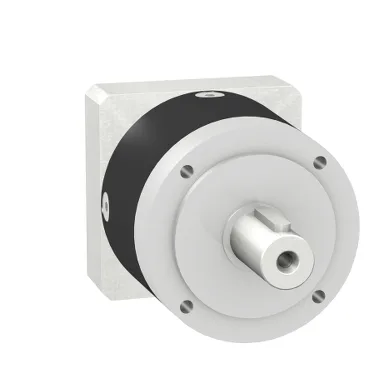
60 mm planetary, 15:1, 44 N.m — what you're getting
The GBX0600150554F: This is a 60 mm diameter planetary gearbox from Schneider Electric's GBX series, with a 15:1 reduction ratio and straight-cut teeth. The continuous output torque is 44 N.m at 100 rpm, with a maximum intermittent rating of 70 N.m at the same speed — the gap between continuous and peak tells you the thermal margin for short overloads. Efficiency is listed at 94 %, which is typical for a single-stage planetary of this size. The noise level at 1 m under no-load is 58 dB — quiet enough for a lab or light assembly line without an enclosure. Service life is 30,000 hours at 100 rpm and 30 °C ambient, lubricated for life — no maintenance schedule for oil changes.
Shaft loads and backlash — the fit constraints
Maximum axial force on the output shaft is 450 N for the full 30,000-hour life, or 600 N if you accept a shorter 10,000-hour service window. Radial force at mid-shaft is 340 N for the long life, 500 N for the shorter one — both at 100 rpm. These are the limits that govern bearing life; overhung loads from a belt or chain drive need to stay within these numbers. Torsional backlash is 20 arc.min maximum — this is a standard-precision gearbox, not a zero-backlash servo unit. For positioning axes that reverse direction, the 20 arc.min lash shows up as lost motion at the load. Torsional rigidity is 2.5 N.m/arcmin — the stiffness under load that determines how much windup you get before the output moves. For a 44 N.m continuous torque, the windup at rated load is about 18 arc.min.
Obsolete — sourcing reality
Schneider Electric lists this gearbox as obsolete. The housing is black anodized aluminium, the output shaft is C45 steel, and the shaft output seal is rated IP54 — splash protection, not washdown. It is a straight-tooth planetary, so it is noisier than a helical but cheaper to produce. Available through independent surplus channels. Quantities are lot-specific and confirmed at RFQ. No pin-compatible drop-in replacement from Schneider is documented.