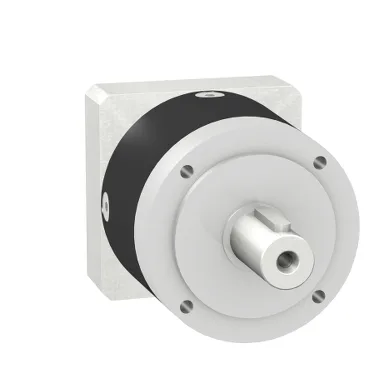
What the torque and backlash numbers mean for your axis
This GBX0600160582D is a 60 mm diameter planetary gearbox with a 16:1 reduction ratio, putting it in the compact precision class for servo-driven indexing or positioning axes. Continuous output torque is 44 N.m, with a peak capability of 70 N.m — the 44 N.m figure is the thermal limit for sustained duty, not the mechanical break point. Torsional backlash is 25 arc.min, which means the output shaft can lag the input by that angle before the gear teeth engage — fine for many pick-and-place or conveyor-index cycles, but check your positioning budget if the application calls for tighter than 0.4° lost motion. Torsional rigidity of 2.5 N.m/arcmin tells you how much the gear train winds up under load; at 44 N.m continuous you get about 17.6 arcmin of wind-up on top of the backlash, so the total positioning uncertainty under load is roughly 42.6 arcmin.
Service life, forces, and the thermal envelope
Rated service life is 30,000 hours at 100 rpm and 30 °C ambient — this is the L10 bearing-and-gear life for the continuous torque case; higher speeds or ambient temperatures above 30 °C reduce that figure. Maximum axial force on the output shaft is 450 N at 100 rpm for the 30,000-hour life target, or 600 N if you accept a 10,000-hour life. Radial force at mid-span is 340 N for 30,000 hours, 500 N for 10,000 hours. These are the limits that determine whether an external belt drive or overhung load needs a separate bearing support. The gearbox is lubricated for life — no oil-change schedule to track. Shaft output seal is rated IP54, meaning it resists dust ingress and splashing water but is not submersible or washdown-rated. The housing is black anodized aluminium; the shaft is C45 steel.
Efficiency and noise — what 94 % and 58 dB actually deliver
94 % efficiency means at 44 N.m output the gearbox dissipates roughly 2.8 N.m worth of heat at the input — enough that a small servo motor won't overheat the gearbox in a sealed enclosure, but plan for natural convection around the 60 mm body if the duty cycle is high. Noise level is 58 dB at 1 m, no-load — that is quieter than a typical office printer and well below the 70 dB threshold that triggers hearing protection requirements in most plants. The straight-tooth design (not helical) is the source; helical gears would be quieter but introduce axial thrust that this gearbox is not designed for.