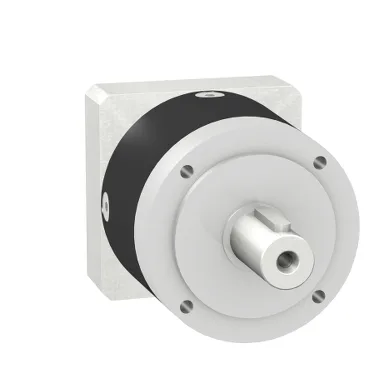
Lifecycle status — obsolete, but we hold stock
Schneider Electric has marked the GBX0600200583D as obsolete. That means the factory line has stopped — no new production runs. But we sourced these before the cut-off, and we still have inventory on hand for the BOM lines that need them. For a motion-control build that already has this gearbox in the design, the 20:1 reduction ratio and 70 N.m peak torque are locked in. If you are planning a new machine, you will want to look at the current GBX-series equivalents — we can help cross-reference the mounting and shaft dimensions against the active catalog.
Torque and duty — what the numbers mean for your axis
The continuous output torque is 44 N.m — that is the load the gearbox can hold all day without overheating the lubricant or stressing the gear teeth. The maximum output torque of 70 N.m covers short peaks during acceleration or reversing, but sustained operation above 44 N.m will shorten the 30,000-hour service life at 100 rpm and 30 °C. At 94 % efficiency, only 6 % of the input power is lost to gear mesh friction and bearing drag. That keeps the heat rise low inside the black anodised aluminium housing, which matters when the gearbox is mounted in a confined space with limited airflow.
Mounting and integration — any position, sealed shaft
The GBX0600200583D mounts in any position — horizontal, vertical, or angled — which simplifies layout on a multi-axis frame. The shaft output carries an IP54 seal, so it resists dust ingress and splashing water; the rest of the housing is sealed by the anodised finish. Shaft material is C45 carbon steel, and the torsional rigidity is 2.5 N.m/arcmin — that is the stiffness the gearbox presents to the load. For a servo-driven axis with tight positioning, this figure tells you how much wind-up you get under load; 2.5 N.m/arcmin means 1 arcmin of twist per 2.5 N.m of applied torque.
Noise and backlash — what 58 dB and 25 arcmin mean on the line
Noise level is 58 dB at 1 m, no-load — that is quiet enough for a lab or clean-room environment where operators stand near the machine. The straight-tooth design is inherently noisier than helical, but the 58 dB figure shows Schneider kept the gear finish tight. Maximum torsional backlash is 25 arcmin — that is the lost motion when the output shaft reverses direction. For indexing or positioning applications that need repeatability under 0.5°, this gearbox is a standard-precision choice; if your cycle requires tighter reversal accuracy, you would step to a low-backlash planetary.