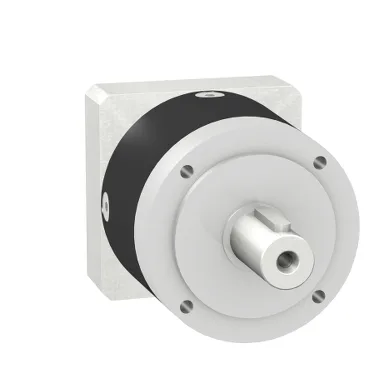
Planetary gearbox for precision motion — 20:1 reduction, 44 N.m continuous
The GBX0600200701F is a straight-tooth planetary gearbox from Schneider Electric's GBX series, sized for servo and stepper motor output stages where compactness and low backlash matter. The 60 mm housing diameter and 20:1 reduction ratio suit it for indexing tables, pick-and-place axes, and conveyor drives that need torque multiplication without a large footprint. Continuous output torque is 44 N.m at 100 rpm, with a maximum intermittent rating of 70 N.m — the 20 arc.min torsional backlash keeps positioning repeatability tight enough for most motion-control applications below precision-robotics grade.
The 44 N.m continuous rating is the figure to size against your duty cycle; the 70 N.m maximum covers acceleration peaks and occasional overloads. Service life is 30000 hours at 100 rpm and 30 °C — derate the life if your application runs hotter or at higher speeds. Maximum radial force on the output shaft is 340 N for the full 30000-hour life, rising to 500 N if you accept a 10000-hour service interval. Axial force limits are 450 N (30000 h) and 600 N (10000 h). The IP54 shaft output seal keeps out dust and splash — fine for dry indoor environments but not washdown. Efficiency is 94 % at rated load, which means about 6 % of input power is lost as heat. The black anodized aluminium housing dissipates that heat without a fan in most duty cycles. Ambient operating range is -25 to 90 °C, and the gearbox is lubricated for life — no maintenance oil changes.
Obsolete — sourcing through independent channels
Schneider Electric has marked the GBX0600200701F as obsolete. The part is available through independent surplus and broker channels — quantities are lot-specific and confirmed at RFQ. For a BOM that needs this exact reduction ratio and torque class, the GBX0600200701F remains a viable replacement part as long as stock exists. No pin-compatible direct substitute is documented; a parametric search within the GBX family for 60 mm, 20:1, and 44 N.m continuous torque may yield a current-production alternative if a board spin is acceptable.