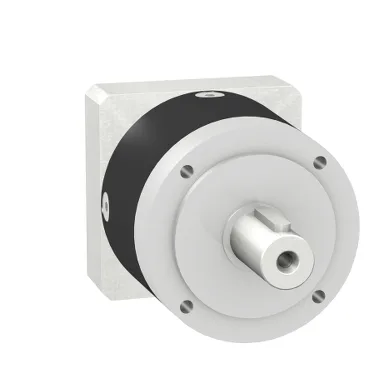
Obsolete — what that means for your BOM
Schneider Electric lists the GBX0600320554F as obsolete. For a line-down or BOM-freeze situation, the only channel is independent surplus — quantities are lot-specific and confirmed at RFQ. No runaround: if you need this exact ratio and torque class, we source it against your order.
Torque and duty-cycle reality
The continuous output torque is 44 N.m at 100 rpm and 30 °C. Maximum output torque hits 70 N.m at the same speed and temperature — that's the short-term peak for acceleration or shock loads, not the rating for steady running. The 32:1 reduction pairs with a motor output around 1.4 N.m at the input to reach that continuous figure, so confirm your motor's stall torque doesn't exceed the gearbox's max input rating.
Service life and load limits
Rated service life is 30,000 hours at 100 rpm and 30 °C. The gearbox is lubricated for life — no oil changes, but the life clock starts the moment it turns. Axial force on the output shaft is capped at 450 N for the full 30,000-hour life, or 600 N if you accept 10,000 hours. Radial force (mid-shaft) is 340 N for 30,000 hours, 500 N for 10,000 hours. Overhang a sprocket or pulley beyond mid-shaft and those radial numbers drop — the force application point matters.
Efficiency, noise, and backlash
Efficiency is 94 % — about 6 % of input power turns to heat inside the housing. At 58 dB at 1 m no-load, this is quiet enough for a machine-tool enclosure or a lab environment; you won't hear it over a typical servo drive fan. Maximum torsional backlash is 20 arc.min — that's standard precision for a straight-tooth planetary, adequate for positioning tables and indexing but not for a zero-backlash servo press application.
Mounting and environmental fit
The housing is black anodized aluminium, 60 mm diameter. Shaft output seal is IP54 — splash-resistant, not submersion. Operating ambient range is -25 to 90 °C, which covers most indoor industrial environments. The shaft is C45 steel, standard medium-carbon grade; if you're coupling to a stainless shaft in a washdown zone, consider a corrosion barrier at the joint.