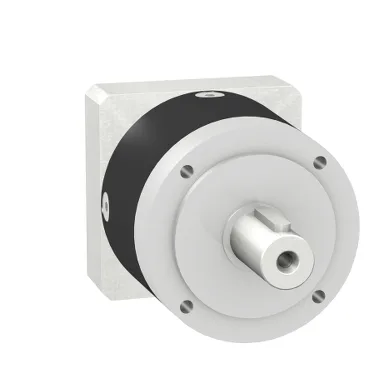
The GBX0600400701F is a 60 mm-diameter planetary gearbox with a 40:1 reduction ratio — it multiplies motor torque by 40 while dividing output speed by the same factor. The continuous output torque is 40 N.m at 100 rpm and 30 °C, with a maximum intermittent torque of 64 N.m under the same conditions. That 40 N.m sustained figure is the one to size against for duty cycles above 60 %; the 64 N.m peak covers acceleration and emergency stops. Efficiency is listed at 94 % — about 6 % of input power is lost as heat in the gear mesh and bearings. For a 400 W motor input, that means roughly 24 W dissipated inside the housing; the black anodized aluminium body (60 mm OD) sheds that heat to ambient without a fan, provided the enclosure around it has some airflow.
Backlash and stiffness — positioning accuracy constraints
Maximum torsional backlash is 20 arcmin — that is the lost motion between input and output when reversing direction. For a positioning axis, this sets the repeatability floor: a 20 arcmin gap at the gearbox output translates to about 0.35 mm of linear error on a 100 mm lever arm. If the application needs better than that, this gearbox is not the fit. Torsional rigidity is 2.5 N.m/arcmin — the shaft wind-up under load. At the continuous 40 N.m, the elastic twist is about 16 arcmin, which adds to the backlash on direction changes. The straight-tooth geometry (no helical angle) means no axial thrust from the gear mesh, but the noise floor is higher than a helical planetary — expect the 55 dB at 1 m no-load to rise under load.
Bearing loads and service life — what limits the duty cycle
Service life is rated 30,000 hours at 100 rpm and 30 °C — that is about 3.4 years of continuous running at that speed. The gearbox is lubricated for life, so no oil-change interval to schedule. The limiting factor is the output bearing: maximum radial force at mid-shaft is 340 N for the 30,000-hour target, or 500 N if you accept a 10,000-hour life. Axial force limits are 450 N (30,000 h) and 600 N (10,000 h). Belt-drive or overhung-load applications need to stay within these numbers or the bearing life drops fast. Ambient operating range is -25 to 90 °C, which covers most industrial enclosures.