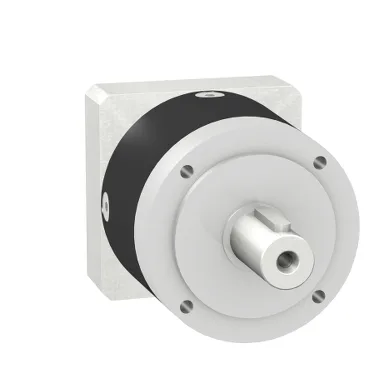
Torque and duty ratings that decide the fit
The GBX0600601004F: This planetary gearbox delivers a continuous output torque of 44 N.m (389.4 lbf.in) at 100 rpm and 30 °C, with a maximum output torque of 70 N.m (619.6 lbf.in) under the same conditions. The reduction ratio is 60:1, which means the input speed is multiplied by 60 relative to the output. For a motor running at 3000 rpm, the output shaft turns at 50 rpm — a typical match for indexing tables, conveyor drives, or positioning stages that need high torque at low speed.
Mechanical constraints — backlash, loads, and environment
Maximum torsional backlash is 22 arc.min — this is a standard-precision planetary, not a zero-backlash unit. For applications that reverse direction under load (pick-and-place, rotary indexing), the lost motion at each reversal adds up; if the positioning tolerance is tighter than a few arc-minutes, a lower-backlash gearbox is needed. The output shaft carries a maximum radial force of 340 N at mid-shaft distance (30,000-hour life) and a maximum axial force of 450 N under the same duty. These limits drop at higher speeds or shorter life targets — the 10,000-hour figures are 500 N radial and 600 N axial. The shaft material is C45 steel; the housing is black anodized aluminium with IP54 protection at the shaft output, meaning it resists dust and splashing water but is not rated for washdown.
Efficiency and noise — what the numbers mean on a real line
Rated efficiency is 94 % — typical for a single-stage planetary with straight teeth at full load. The 6 % loss is mostly gear mesh friction and churning; it shows up as heat in the housing. The noise level is 58 dB at 1 m, no-load, which is quiet enough for a lab or assembly area but not silent — the straight-tooth profile generates a characteristic whine under load that helical gears would reduce.