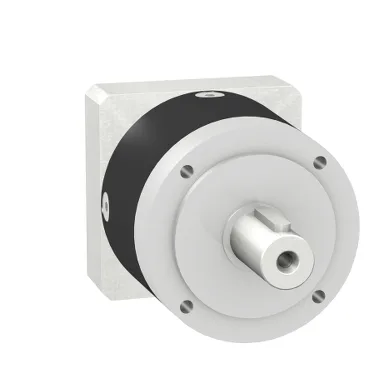
The GBX0600601404F: This is a 60 mm-frame planetary gearbox with a 60:1 reduction ratio, straight teeth, and a continuous output torque rating of 44 N.m at 100 rpm. That continuous figure — not the 70 N.m maximum — is the one that governs duty-cycle sizing for a servo or stepper axis; the maximum figure assumes intermittent peak loading, not sustained operation. Efficiency is listed at 94 %, which is typical for a single-stage planetary of this class and means roughly 6 % of the input power dissipates as heat in the gear mesh. The torsional rigidity of 2.5 N.m/arcmin and maximum backlash of 22 arc.min tell you the windup and lost motion under reversing loads — relevant if the downstream ball screw or belt stage has its own compliance budget. The noise level at 58 dB at 1 m, no-load, is a reference figure; under load the mesh harmonics shift and the actual cabin-level noise depends on the mounting structure's resonance. The IP54 rating on the shaft output means the seal keeps out dust and splashing water but is not rated for washdown — keep it inside a cabinet or under a cover if the line sees hose-down cleaning.
Obsolete — sourcing through independent channels
Schneider Electric lists this gearbox as obsolete. The part is sourced through independent surplus and broker channels; quantities are lot-specific and confirmed at RFQ. Service life is stated at 30,000 hours at 100 rpm and 30 °C ambient, lubricated for life — no oil-change interval. The ambient operating range of -25 to 90 °C is wide enough for most indoor industrial environments, but the 30,000-hour life figure assumes the 30 °C reference; running at the upper end of the temperature range accelerates grease degradation and reduces bearing life. Axial and radial force limits are derated with service life: 450 N axial and 340 N radial for the 30,000-hour target, stepping up to 600 N and 500 N respectively if the application accepts a 10,000-hour life. These limits apply at 100 rpm with the radial load applied at mid-span on the output shaft — overhung loads closer to the bearing face reduce the allowable radial force.