What the 9:1 ratio and 130 N.m mean on a motion axis
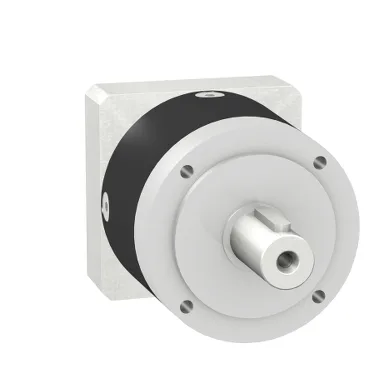
This GBX0800090703D is a planetary gearbox from Schneider's GBX series, 80 mm diameter, with a 9:1 reduction ratio. That means the output shaft turns once for every nine input revolutions, multiplying the motor's torque by roughly the same factor minus the 94% efficiency loss. The continuous output torque rating is 130 N.m — this is the torque the gearbox can deliver indefinitely without overheating or accelerated wear. Peak load capability is 208 N.m maximum output torque, useful for acceleration or momentary overloads. Maximum torsional backlash is 17 arc.min, and torsional rigidity is 6.5 N.m/arcmin. For a positioning axis, backlash affects repeatability in direction reversals; the rigidity figure tells you how much the shaft twists under load — 6.5 N.m per arcminute of windup.
Service life, loads, and when to derate
Rated service life is 30000 hours at 100 rpm output speed and 30 °C ambient. That's about 3.4 years of continuous running at that speed. The gearbox is lubricated for life — no oil changes, no maintenance schedule. Maximum axial force on the output shaft is 1200 N at 100 rpm for a 10000-hour life, or 900 N if you need the full 30000 hours. Radial force limits are 950 N and 650 N respectively, with the force applied at mid-distance on the output shaft. Overhung loads from pulleys or sprockets need to stay within these numbers or the output bearing life drops fast. The IP54 rating on the shaft output means it's protected against dust ingress and splashing water — fine for most industrial enclosures but not for washdown.
Mounting and physical fit
Housing is black anodized aluminium — lightweight, corrosion-resistant. The shaft is C45 steel, a standard medium-carbon grade with good strength for this torque class. Moment of inertia reflected to the input is 0.74 g.cm². For a servo application, the total inertia ratio (load + gearbox reflected to motor shaft) determines tuning stability — this gearbox adds a small fraction to the reflected load. Straight-tooth gearing rather than helical means slightly higher noise at speed — 60 dB at 1 m, no-load — but lower cost and no axial thrust on the bearings. The noise figure is measured at the gearbox itself, not the driven load.