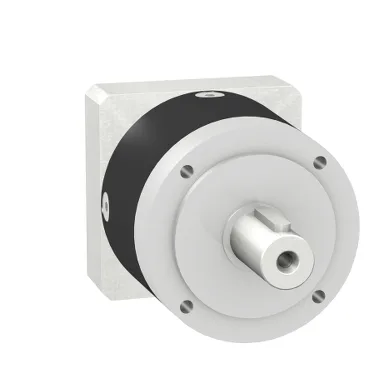
Planetary gearbox, 80 mm, 12:1 — where the torque ratings matter
The GBX0800120554F: This is a straight-tooth planetary gearbox in the 80 mm frame size, with a 12:1 reduction ratio. The continuous output torque is 120 N.m at 100 rpm; the maximum intermittent torque hits 192 N.m at the same speed. That 60% headroom matters when the load has short-duration peaks during acceleration or reversing — the gearbox can handle them, just not continuously. Efficiency is 94 %, which is typical for a single-stage planetary at this ratio. The 6% loss shows up as heat in the gearbox body — at full load, that's about 7.7 W thermal dissipation. In a confined enclosure, that heat needs somewhere to go; the black anodized aluminium housing radiates it, but don't bury it against a panel wall without airflow. Noise level is 60 dB at 1 m, no-load. That's quieter than a typical conveyor drive under load — about the hum of a small office printer. For a machine running in an occupied space, this gearbox won't be the noise problem.
Obsolete — sourcing through independent channels
Schneider Electric lists this gearbox as obsolete. If you're planning a replacement, the functional spec to match is the 80 mm frame, 12:1 ratio, and 120 N.m continuous torque at the output shaft. The straight-tooth planetary construction and the IP54 shaft seal are also constraints — a helical or right-angle box won't drop in without a mounting rework. Service life is rated 30,000 hours at 100 rpm and 30 °C ambient — that's about 3.4 years of continuous running. The gearbox is lubricated for life, so there's no oil-change interval to track. The IP54 shaft output seal means it's protected against dust ingress and water splash, but not pressurized washdown.
Shaft loading and environmental limits
Maximum axial force on the output shaft is 1200 N for a 10,000-hour life, dropping to 900 N for the full 30,000-hour rating — both at 100 rpm and 30 °C. Radial force limits are 950 N (10,000 h) and 650 N (30,000 h), applied at mid-span on the output shaft. If your application overhangs a sprocket or pulley beyond mid-shaft, the radial capacity drops further. Torsional rigidity is 6.5 N.m/arcmin — that's the stiffness of the gear train. For a positioning application, the total backlash is up to 14 arcmin, which is typical for a commercial planetary at this price point. That's fine for indexing or conveyor positioning; not suitable for a servo axis without a separate preload or dual-motor anti-backlash scheme.