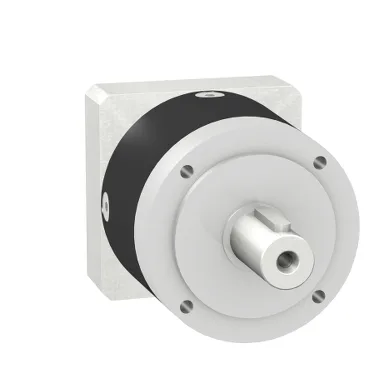
Torque ratings and duty cycle — continuous vs peak
The GBX0800150841D delivers 110 N.m continuous output torque with a maximum peak of 176 N.m. That 60% headroom above continuous is what you budget for acceleration transients or occasional overloads — the gearbox can handle short bursts above the continuous rating without damage, but sustained operation at peak torque will shorten the 30,000-hour service life at 100 rpm and 30°C. The 15:1 reduction ratio means the input speed is 15 times the output speed, with torque multiplied by roughly the same factor minus efficiency losses. At 94% efficiency, only 6% of the input power is lost as heat — that keeps the gearbox cool enough that the lifetime lubrication (no oil changes needed) stays within its thermal budget across the -25 to 90°C ambient range.
Stiffness and backlash — positioning accuracy limits
Torsional rigidity is 6.5 N.m per arcminute of windup. For a reversing or indexing drive, that stiffness determines how much angular error you get under load before the gear teeth engage fully. The maximum torsional backlash is 17 arcminutes — that's the lost motion when reversing direction, unloaded. If your application needs better than 17 arcmin repeatability, you'll need a lower-backlash gearbox or a preloaded dual-motor arrangement. The straight-tooth design (not helical) means the gear mesh is noisier but more efficient and cheaper to manufacture. Noise level is 60 dB at 1 meter, no-load — that's about the level of a quiet office conversation. In a machine with other rotating equipment, the gearbox won't be the dominant noise source unless it's the only thing running.
Shaft loading — axial and radial force limits
Maximum axial force (Fa) on the output shaft is 1200 N at 100 rpm for a 10,000-hour life, dropping to 900 N for the full 30,000-hour rating. Radial force (Fr) applied at mid-shaft is 950 N for 10,000 hours or 650 N for 30,000 hours. These are the limits for the output bearing — overhung loads from belt drives or direct-coupled loads that exceed these numbers will shorten bearing life faster than the torque rating suggests. The shaft material is C45 carbon steel — standard medium-carbon grade with good strength and wear resistance for keyed or clamped connections. The IP54 rating at the shaft output means the seal keeps out dust and splashing water, but the gearbox housing itself is not sealed; the anodized aluminium body (black) is the structural enclosure, not a pressurized vessel.