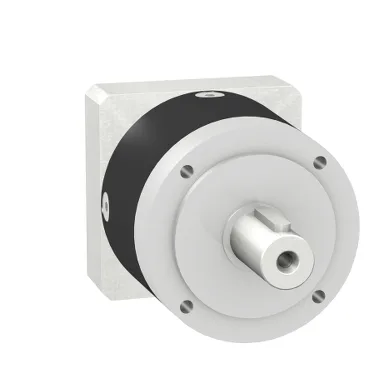
16:1 planetary stage, 120 N.m continuous
The GBX0800160841D is a straight-tooth planetary gearbox from the Schneider GBX series, 80 mm diameter, delivering a 16:1 reduction ratio. Continuous output torque is 120 N.m, with a maximum of 192 N.m for intermittent peaks — the continuous figure governs the duty cycle in a servo or stepper application. Efficiency is listed at 94 %, which means about 6 % of input power is lost as heat through the gear mesh — relevant for thermal budgeting in a closed-loop axis. Noise level is 60 dB at 1 m, no-load, typical for a precision planetary stage at this size.
Backlash and service life — the real fit constraints
Maximum torsional backlash is 17 arc.min — this is the angular play at the output shaft when reversing direction. For a positioning axis with a ball screw, 17 arc.min translates to a predictable lost motion; if the application needs tighter than 10 arc.min, this gearbox is not the right fit. Service life is rated 30,000 hours at 100 rpm and 30 °C ambient. The axial and radial force limits are also tied to speed and life: 1200 N axial (Fa) at 100 rpm for 10,000 hours, dropping to 900 N for the full 30,000-hour window. Radial force (Fr) at mid-shaft is 650 N for 30,000 hours, 950 N for 10,000 hours. These are the numbers to check against the output bearing load from a belt or pinion. The housing is black anodized aluminium, shaft is C45 steel. Shaft output seal is IP54 — splash-resistant but not washdown-rated. Lubricated for life, so no maintenance interval for grease changes.
Obsolete — sourcing through independent channels
Schneider Electric lists the GBX0800160841D as obsolete. The part is available through independent surplus and broker channels — quantities are lot-specific and confirmed at RFQ. For a BOM freeze or a repair, the GBX series shares the same 80 mm housing and mounting pattern across reduction ratios, so a different ratio (e.g. 10:1 or 20:1) from the same family may fit the same mechanical interface — but the ratio change shifts the torque and speed profile, so the motor-side tuning and load calculations need rechecking.