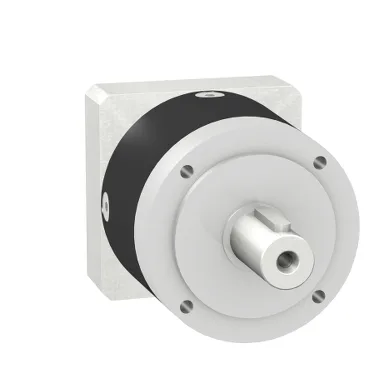
The GBX0800161404F is a straight-tooth planetary gearbox in an 80 mm diameter housing, delivering a 16:1 reduction ratio. It is designed to multiply servo or stepper motor torque while maintaining positional accuracy in a compact footprint — the kind of gearbox you spec between a motor and a ballscrew or conveyor drive. Continuous output torque is 120 N.m at 100 rpm and 30 °C, with a maximum intermittent torque of 192 N.m at the same speed and temperature. The 94 % efficiency means only 6 % of the input power is lost to gear mesh friction — a meaningful number when sizing the motor for a duty cycle that runs near the continuous limit. Torsional backlash is rated at 14 arc.min — this is the lost motion at the output shaft when the input reverses direction. For indexing or pick-and-place axes where repeatability matters, that figure tells you how much angular slop the downstream load sees before the gear train engages. The 6.5 N.m/arcmin torsional rigidity gives the stiffness profile for preload calculations in a closed-loop system.
Sourcing reality — obsolete, available through independent channels
Stock is sourced through independent surplus and broker channels. Quantities are lot-specific — confirmed at RFQ against the BOM line. Service life is rated at 30,000 hours at 100 rpm and 30 °C with the lubricated-for-life grease charge. The axial and radial load capacities are derated for longer life: maximum axial force Fa is 1200 N for 10,000 hours or 900 N for 30,000 hours; maximum radial force Fr is 950 N for 10,000 hours or 650 N for 30,000 hours, both at 100 rpm and 30 °C.
Integration notes — IP54 shaft seal, temperature range, noise floor
The shaft output carries an IP54 rating — protected against dust ingress and splashing water at the seal. This is adequate for most indoor machine builds but not for washdown environments. The housing is black anodized aluminium; the shaft is C45 steel. Ambient operating range is -25 to 90 °C. Noise level is 60 dB at 1 m under no-load conditions — a straight-tooth gearbox is inherently noisier than a helical at the same ratio, so factor this into the machine acoustic specification if the axis runs at high speed unloaded.