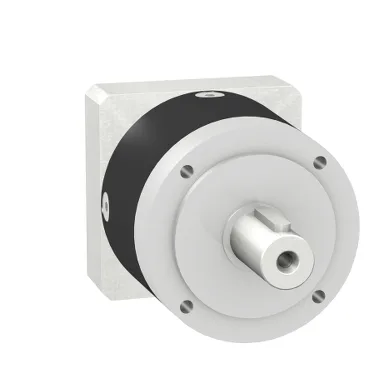
Planetary gearbox for precision motion — 80 mm frame, 20:1 reduction
The GBX0800200553F is a Schneider Electric planetary gearbox with a straight-tooth design, 80 mm outer diameter, and a 20:1 reduction ratio. It delivers 120 N.m continuous output torque at 100 rpm, with a maximum intermittent torque of 192 N.m under the same conditions. Rated service life is 30,000 hours at 100 rpm and 30 °C, with the gearbox lubricated for life — no maintenance interval for oil changes.
Torque, backlash, and stiffness — the numbers that govern the fit
Continuous torque rating of 120 N.m sets the thermal limit for steady-state operation; the peak torque of 192 N.m handles acceleration and emergency stops but is limited to the 100 rpm condition. Torsional rigidity is 6.5 N.m/arcmin, meaning the gearbox twists 1 arcminute per 6.5 N.m of applied torque — relevant for positioning accuracy in indexing applications. Maximum torsional backlash is 14 arcmin — this is the lost motion at the output shaft when reversing direction. For single-direction constant-load drives the backlash is less critical; for bidirectional positioning or servo loops it determines the deadband the controller must compensate. Efficiency is 94 %, meaning 6 % of input power is lost as heat in the gear mesh. At 120 N.m output and 100 rpm, the heat loss is about 80 W — the black anodized aluminium housing (80 mm diameter) dissipates this without forced cooling in the rated ambient range.
Sourcing an obsolete planetary gearbox
Available through independent distribution channels; quantities are lot-specific and confirmed at RFQ.
Environmental and mechanical limits for integration
Shaft output seal rated IP54 — the gearbox is protected against dust ingress and splashing water, but not submersion or high-pressure washdown. Maximum axial force on the output shaft is 900 N for the 30,000-hour service life at 100 rpm; radial force limit is 650 N applied at mid-span of the shaft extension. Exceeding these loads shortens bearing life faster than the gear mesh wear. Noise level is 60 dB at 1 m under no-load conditions — typical for a straight-tooth planetary stage of this size. Under load the noise increases with torque and speed; the 60 dB figure is a baseline for comparison, not an in-service guarantee.