Sizing this gearbox to the load
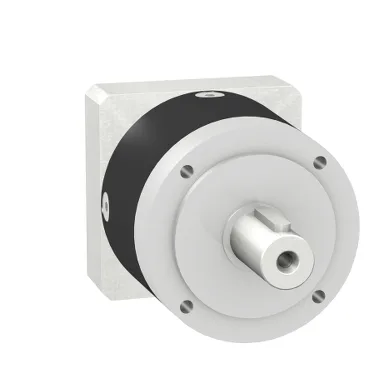
The GBX0800250553F is a straight-tooth planetary gearbox in the GBX series, 80 mm outer diameter, with a 25:1 reduction ratio. It delivers a continuous output torque of 110 N.m (973.6 lbf.in) at 100 rpm and 86 °F (30 °C), and can handle a maximum output torque of 176 N.m (1557.7 lbf.in) under the same conditions — the 60 % headroom above continuous is useful for acceleration peaks or occasional overloads, but the service life rating of 30000 hours at 100 rpm assumes continuous torque, not peak. The 25:1 ratio means the output shaft turns once for every 25 input revolutions. At a typical servo motor base speed of 3000 rpm, the output runs at 120 rpm — right in the band where the torque ratings are specified. Efficiency is 94 %, so about 6 % of the input power is lost as heat in the gear mesh and bearings.
Mounting and environmental limits
Mounts in any position — no oil drain orientation to worry about, since it's lubricated for life (no maintenance refill). The housing is black anodized aluminium, the shaft is C45 steel. Ambient operating range is -25 to 90 °C (-13 to 194 °F), which covers most indoor industrial environments and many outdoor cabinets in temperate climates. The shaft output seal is IP54 — fine for dry indoor duty but not washdown; keep it out of direct spray. Radial and axial load limits drop with service life target. At 30000 hours, 100 rpm, 30 °C, the maximum radial force (applied mid-shaft) is 650 N, and the maximum axial force is 900 N. For a 10000-hour life target, those figures climb to 950 N radial and 1200 N axial — useful for short-life or serviceable applications where the gearbox is swapped before end of life.
Backlash and rigidity for positioning
Maximum torsional backlash is 14 arc.min — that's the angular play between input and output when the direction reverses. For a 25:1 gearbox, this is a standard-precision class, not a zero-backlash stage. If the application does pick-and-place or indexing with frequent reversals, the 14 arc.min will show up as lost motion at the tool tip; for continuous rotation or conveyor drives it's invisible. Torsional rigidity is 6.5 N.m/arcmin, meaning the gear train winds up 1 arcmin for every 6.5 N.m of applied torque — this stiffness matters when the load has high inertia and the servo loop gains are pushed.