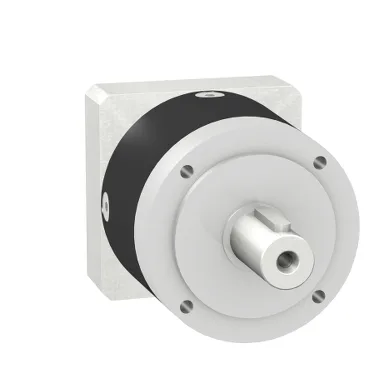
Torque ratings and what they mean for sizing
The GBX0800320553F: Continuous output torque is 120 N.m at 100 rpm and 30 °C ambient — this is the thermal limit for sustained duty. The maximum output torque reaches 192 N.m under the same conditions, which covers acceleration peaks and intermittent overloads without exceeding the gear's mechanical limit. The 14 arcmin maximum torsional backlash is a positioning accuracy spec: for a servo axis reversing direction, that's the lost motion before the output shaft picks up the load. If your application needs tighter than 14 arcmin, this gearbox won't hold position on direction changes. Torsional rigidity is 6.5 N.m/arcmin — under load the shaft winds up about 0.15 arcmin per N.m of applied torque. This matters for stiffness in the servo loop; a low-rigidity gearbox can excite resonance in a high-gain axis.
Mechanical interface and environmental limits
The housing is black anodized aluminium, 80 mm external diameter, with a C45 steel output shaft. IP54 at the shaft output means it's protected against dust ingress and splashing water — suitable for machine interiors but not washdown zones. It's lubricated for life — no maintenance port for regreasing, so the 30,000-hour service life at 100 rpm and 30 °C is the practical replacement interval. Maximum radial force at the output shaft mid-point is 650 N for the 30,000-hour life target, or 950 N if you accept a 10,000-hour service life. Axial force limits are 900 N for 30,000 hours and 1200 N for 10,000 hours. These are the bearing load limits — overhang a pulley or sprocket beyond the shaft midpoint and you reduce the allowable radial load.
Efficiency and noise — what the numbers tell you
Rated 94% efficiency — about 6% of the input power is lost as heat in the gear mesh and bearings. For a 120 N.m continuous output at 100 rpm (roughly 1.26 kW mechanical), expect about 80 W of heat to dissipate through the aluminium housing. No separate cooling is needed at this duty point. Noise level is 60 dB at 1 m, no-load — a moderate figure for a straight-tooth planetary. Under load the noise will rise with torque; straight teeth are inherently noisier than helical, so if acoustic specs are tight, factor in enclosure attenuation.