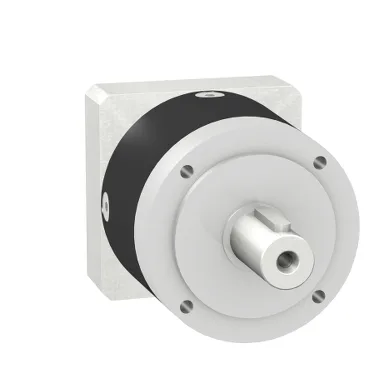
40:1 planetary, 110 N.m continuous — what the ratings mean
The GBX0800400551F is a straight-tooth planetary gearbox from Schneider Electric's GBX series, 80 mm diameter, with a 40:1 reduction ratio. That ratio multiplies input motor torque by 40 while dividing output speed by the same factor — a common spec for indexing tables, conveyor drives, and positioning axes where you need high torque at low rpm from a servo or stepper motor. The continuous output torque is 110 N.m at 100 rpm and 30 °C — this is the torque the gearbox can deliver indefinitely without overheating or accelerated wear. The maximum output torque is 176 N.m under the same conditions, but that's a peak rating for occasional overloads, not a steady-state figure. For a sizing decision, the 110 N.m continuous number is the one to design around. Efficiency is listed at 94 %, which is typical for a single-stage planetary. That means 6 % of input power is lost as heat inside the gearbox — negligible for most applications but worth accounting for in a thermally sensitive enclosure or if the duty cycle is high. Torsional backlash is 14 arc.min maximum — this is the angular play between input and output when direction reverses. For positioning applications, 14 arc.min is moderate; a precision indexing table would need a lower-backlash unit, while a simple conveyor or agitator drive won't notice it.
Load ratings and service life — the real-world limits
Service life is rated at 30,000 hours at 100 rpm and 30 °C. That's about 3.4 years of continuous operation — typical for a lubricated-for-life gearbox where the grease degrades over time. If you run it at higher speed or temperature, the life shortens; the axial and radial force ratings also drop if you push beyond the 30,000-hour baseline. Maximum axial force Fa is 1200 N for a 10,000-hour life at 100 rpm and 30 °C, dropping to 900 N for the full 30,000-hour rating. Maximum radial force Fr is 950 N for 10,000 hours and 650 N for 30,000 hours, measured at mid-span on the output shaft. These limits govern bearing life — exceeding them shortens the gearbox life faster than torque overload does. Torsional rigidity is 6.5 N.m/arcmin — a measure of how much the gearbox twists under load. At the continuous torque of 110 N.m, the windup is about 17 arcmin (110 ÷ 6.5). This matters for servo applications where torsional stiffness affects the control loop's bandwidth and settling time.
Obsolete — sourcing through independent channels
Schneider Electric lists the GBX0800400551F as obsolete. The GBX series has been superseded by newer planetary gearbox families, but there is no direct pin-for-pin or bolt-in replacement — a new gearbox selection and possibly a mounting adapter would be needed. For a line-down situation or a BOM that needs this exact part, the gearbox is available through independent surplus and broker channels. Quantities are lot-specific — confirmed at RFQ. The lubricated-for-life design means a low-hours pull from a decommissioned line is often functionally equivalent to new stock, as long as the input and output seals are intact and the gearbox hasn't been stored in a corrosive environment. The black anodized aluminium housing and C45 steel shaft are standard industrial materials; corrosion resistance is adequate for dry indoor use.