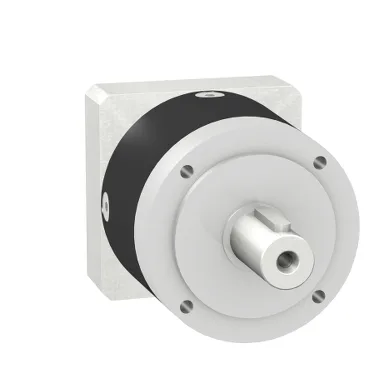
40:1 planetary, 110 N.m continuous — the torque and ratio that matter
The GBX0800401401F is a straight-tooth planetary gearbox from Schneider Electric's GBX series, with an 80 mm outer diameter and a 40:1 reduction ratio. Its continuous output torque is rated at 110 N.m (973.6 lbf.in) at 100 rpm and 30 °C, and it can deliver a maximum of 176 N.m (1557.7 lbf.in) under the same conditions. That 40:1 ratio means the input shaft turns 40 times for every output revolution — a typical spec for indexing tables, conveyor drives, or positioning axes where you need speed reduction and torque multiplication in a compact package.
94 % efficiency, 60 dB noise — what the numbers mean on the line
Efficiency is listed at 94 %, which is typical for a single-stage planetary. That figure accounts for gear mesh losses and bearing drag; at 110 N.m output, about 7 N.m of input torque is lost to friction and heat. The noise level is 60 dB at 1 m, no-load — roughly the hum of a quiet office, not silent but well below the threshold where it would mask audible alarms on a production floor. Service life is rated at 30,000 hours at 100 rpm and 30 °C. That's about 3.4 years of continuous 24/7 operation before the gearbox reaches its L10 life — the point at which 10 % of a population would need replacement. The unit is lubricated for life, so no oil changes or regreasing intervals to schedule. Maximum torsional backlash is 14 arc.min — that's the angular play between input and output when direction reverses. For positioning applications, this is the number that determines repeatability; 14 arc.min is a standard precision grade, not a zero-backlash unit, so it suits indexing and conveying more than servo-grade positioning.
Sourcing an obsolete GBX — what to expect
For a BOM that needs this exact ratio and frame size, the supply path is a quoted-to-order RFQ against available surplus inventory. Quantities are lot-specific and confirmed at quote time. If your application allows a frame-size change, a current-production planetary from the same torque class may be a cleaner long-term fit — but that requires a mechanical re-check of the mounting interface and shaft dimensions.
Mounting and mechanical limits — shaft loads and environment
The output shaft is C45 steel, and the housing is black anodized aluminium. The shaft output seal carries an IP54 rating — splash-proof but not submersible, so keep it out of washdown zones or direct hose spray. Ambient operating range is -25 to 90 °C. Maximum axial force (Fa) on the output shaft is 1200 N at 100 rpm for a 10,000-hour life, dropping to 900 N for the full 30,000-hour rating. Maximum radial force (Fr) applied at mid-shaft is 950 N for 10,000 hours or 650 N for 30,000 hours. These are the limits that govern bearing life — overhang a sprocket or pulley beyond mid-shaft and the radial capacity drops further. Torsional rigidity is 6.5 N.m/arcmin — a measure of how much the gearbox twists under load. At the continuous torque of 110 N.m, that works out to about 17 arcmin of wind-up, which adds to the backlash when the load reverses.