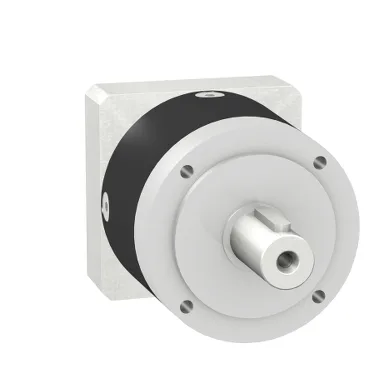
The GBX0800401404F is a straight-tooth planetary gearbox from Schneider Electric's GBX series, with an 80 mm housing diameter and a 40:1 reduction ratio. That 40:1 step-down means the output shaft turns once for every forty input revolutions — a common ratio for indexing tables, conveyor drives, and positioning axes where you need torque multiplication without a secondary belt stage. Continuous output torque is 110 N.m at 100 rpm and 30 °C ambient, with a maximum intermittent torque of 176 N.m under the same conditions. The 94 % efficiency figure is the mechanical loss through the planetary stages — at 110 N.m output, roughly 7 N.m of that is absorbed by gear mesh and bearing drag, which shows up as heat in the housing. Torsional backlash is rated at 14 arc.min maximum — that's the angular play between input and output when reversing direction. For a positioning application, 14 arc.min on a 40:1 gearbox translates to about 0.35 arc.min at the input side; acceptable for general-purpose indexing but too loose for a servo axis that needs to hold position within a few arc-seconds.
Sourcing reality — obsolete, quoted to order
If you are maintaining an existing machine that uses this gearbox, the 80 mm frame size and 40:1 ratio are the binding constraints for a drop-in replacement. A parametric cross-reference to a current-series planetary gearbox with matching diameter, ratio, and output torque is the practical path — confirm the input shaft dimensions and mounting pattern before committing.
Service life, lubrication, and environmental limits
Rated service life is 30,000 hours at 100 rpm and 30 °C ambient — that is about 3.4 years of continuous 24/7 operation at that speed. The gearbox is lubricated for life, so no oil-change intervals or breather maintenance; the grease fill is sealed at the factory and intended to last the full service life. Shaft output sealing is rated IP54, which means the output shaft seal keeps out dust and splashing water but is not submersible. The housing is black anodized aluminium — good corrosion resistance in dry indoor environments but not rated for washdown or outdoor exposure without a cover. Ambient operating range is -25 °C to +90 °C. The lubricant viscosity is selected for that window; below -25 °C the grease stiffens enough to increase starting torque noticeably, and above 90 °C the seal life shortens. Maximum axial force on the output shaft is 1200 N at 100 rpm for a 10,000-hour life, derated to 900 N for the full 30,000-hour target. Radial force limits are 950 N at 100 rpm for 10,000 hours, dropping to 650 N for 30,000 hours — both measured at mid-span on the output shaft.
Noise, torsional stiffness, and shaft materials
Noise level is 60 dB at 1 m under no-load conditions. That is about the level of a quiet office printer — noticeable but not intrusive in a machine room. The torsional rigidity of 6.5 N.m/arcmin means the gearbox twists about 0.15 arcmin per N.m of applied torque; for a 110 N.m load, the wind-up under full continuous torque is roughly 17 arcmin at the output, which the positioning system must account for in its stiffness loop. Shaft material is C45 carbon steel — standard medium-carbon grade with good wear resistance for the gear teeth and bearing journals. The straight-tooth design is simpler and more cost-effective than helical, but generates more audible gear whine at higher speeds; at the rated 100 rpm it is not a concern.