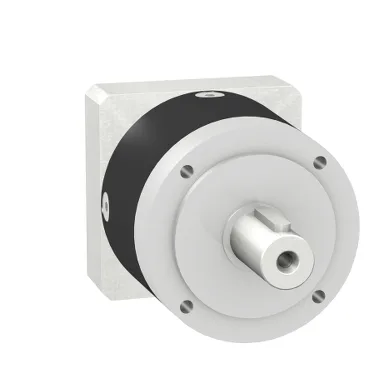
120 mm planetary, 3:1, 115 N.m — what the ratings mean
The GBX1200031082D is a straight-tooth planetary gearbox from Schneider Electric's GBX series, 120 mm in diameter with a 3:1 reduction ratio. Efficiency is listed at 96 %, which means about 4 % of the input power is lost as heat through the gear mesh and bearing drag. At 115 N.m output, that loss is manageable in a well-ventilated enclosure, but the 30,000-hour service life rating at 100 rpm and 30 °C assumes the gearbox stays within its thermal envelope — derate speed or torque in hotter cabinets. Backlash is 8 arc.min maximum — this is a standard-precision grade, not a zero-backlash unit. For indexing or positioning axes where reversal error matters, the 8 arc.min figure translates to about 0.13° of lost motion at the output; factor that into the position loop budget.
Load limits and mounting — axial, radial, and position
Maximum axial force (Fa) is 2100 N at 100 rpm for the 30,000-hour life target, or 2800 N if you accept a 10,000-hour service life. Radial force (Fr) at mid-span on the output shaft is 1500 N for the longer life, 2000 N for the shorter. These are the hard limits for overhung loads like pulleys or pinions — exceed them and the output bearing life drops fast. The gearbox can be mounted in any position, which simplifies layout in a tight machine frame. The housing is black anodized aluminium; the output shaft is C45 steel. Shaft output sealing is IP54 — splash-resistant but not submersible, so keep it out of direct washdown spray. Torsional rigidity is 12 N.m/arcmin — this is the stiffness of the gear train under load. For a 115 N.m continuous torque, the wind-up at the output is about 9.6 arcmin under full load, which adds to the backlash figure in a closed-loop system.
Lifecycle reality — obsolete, sourced to order
Schneider Electric lists the GBX1200031082D as obsolete. The gearbox is lubricated for life, so no maintenance oil changes are needed. The 30,000-hour service life at 100 rpm and 30 °C is the design target — running at higher speeds, higher ambient temperatures, or higher loads will reduce that figure proportionally. The noise level is 65 dB at 1 m, no-load — typical for a planetary gearbox of this size; expect a few dB higher under full load.